The Reactivity Study on N3,N3-(3-Oxapentan-1,5-diyl)-N1-(2-phenyl-3,4- dihydroquinazolin-4-yliden)Thiourea
Walid Fathalla1, Michal Cajan1,2, Jaromir Marek3 and Pavel Pazdera1*
Received: 20 August 2001 / Uploaded 21 August 2001
Abstract:
The results of reactivity study on the model N3,N3-(3-oxapentan-1,5-diyl)-N1-(2-phenyl-3,4-dihydroquinazolin-4-yliden)thiourea 1 are described. Compound 1 produces S-alkyl derivatives with alkyl halides. Compound 1 also undergoes transamination reactions to afford N3,N3-di-R-N1-(2-phenyl-3,4-dihydroquinazolin-4-yliden)thioureas and N3-R-N1-(2-phenylquinazolin-4-yl)thioureas and oxidative desulfurization with amines in H2O2 to provide N4-di-R-N'4-(2-phenylquinazolin-4-yl)morpholin-4-carboximidamide . Estimation of reactivity site on 1 was provided using the ab initio quantum chemistry computations.
FTIR, 1H NMR, 13C NMR, mass spectroscopy and X-ray identified compounds.
Keywords:
N3,N3-(3-oxapentan-1,5-diyl)-N1-(2-phenyl-3,4-dihydroquinazolin-4-yliden)thiourea,
thioamide reactivity, transamination, oxidative desulfurization, guanidines, thioureas
Contents:
The nucleophilic S/N competition reactions with electrophiles in a thioamide structural fragment were considered as essential element for the preparation of a number of heterocyclic compounds. These types of reactions despite it show great selectivity, but the reason for the S- and N-atoms contributions were not yet described.
The competition between the sulfur and nitrogen atoms in a thioamide moiety towards intermolecular and intramolecular reactions with electrophiles was continued [1-4].
The structure of N3,N3-(3-oxapentan-1,5-diyl)-N1-(2-phenyl-3,4-dihydroquinazolin-4-ylidene)thiourea 1 is an excellent precursor for this type of studies.
2. Synthesis of Investigated compound
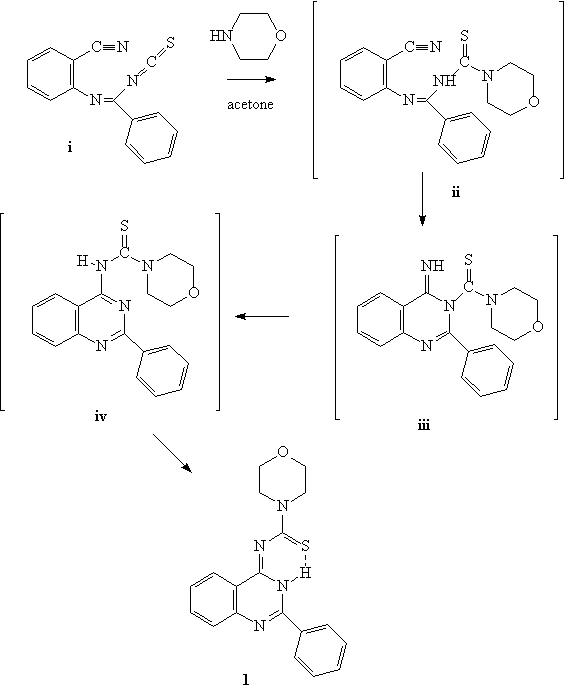
The model compound 1 was prepared as described [1] by the one pot reaction of N-(2-cyanophenyl)benzimidoyl isothicyanate with morpholine to principally give the intermediate
N4-[[(2-cyanophenyl)imino](phenyl)methyl]morpholin-4-carbothioamide ii followed by a regioselective intramolecular cycloaddition reaction by the nitrogen atom at the cyano group to give the quinazoline derivative iii. The quinazoline iii undergoes Dimroth rearrangement reaction to give the quinazoline-4yl-thiourea iv and finally tautomerisation to provide N3,N3-(3-oxapentan-1,5-diyl)-N1-(2-phenyl-3,4-dihydroquinazolin-4-yliden)thiourea 1 (Scheme 1).
Scheme 1. Preparation of N3,N3-(3-oxapentan-1,5-diyl)-N1-(2-phenyl-3,4-dihydroquinazolin-4-yliden)thiourea 1.
The ab initio computational analysis of N3,N3-(butan-1,4-diyl)-N1-(2-phenyl-3,4-dihydro-quinazolin-4-yliden)thiourea Figure 2 together with the X-ray analysis Figure 1 show that the compound 1 is almost planar having the phenyl ring at position 2 and the pyrrolidine methylene groups slightly out of plane. The electrons in p -orbitals are in good conjugation as presented in Figure 2. The hydrogen bond interactions between the thiocarbonyl group and the NH of the quinazoline ring adding an extra stability to the isolated product 1. These hydrogen bond interactions were identified from the X-ray analysis and the computational studies, which show a bond distance of about 2.17 and 2.18 Å, respectively.
The energy difference between the competing structures 1 and iv is 36.61 kcal mol-1. This shows that the more stable compound is the isolated quinazoline derivative 1.
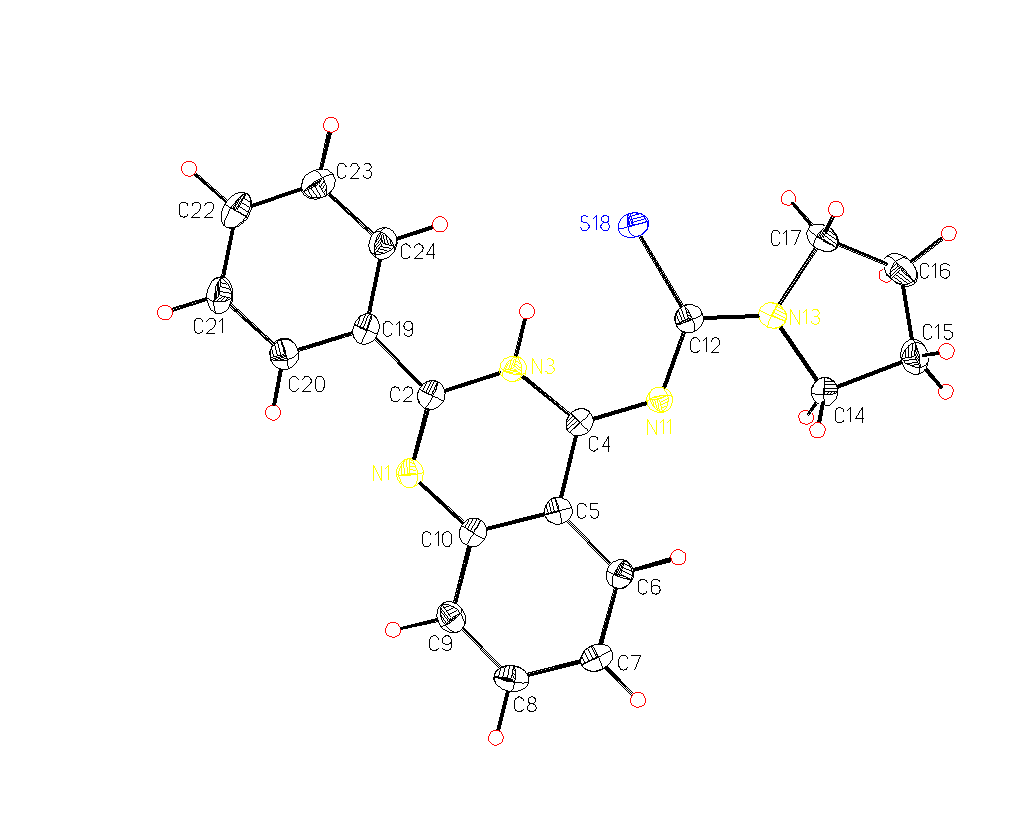
Figure 1. ORTEP diagram of N3,N3-(butan-1,4-diyl)-N1-(2-phenyl-3,4-dihydroquinazolin-4-yliden)thiourea
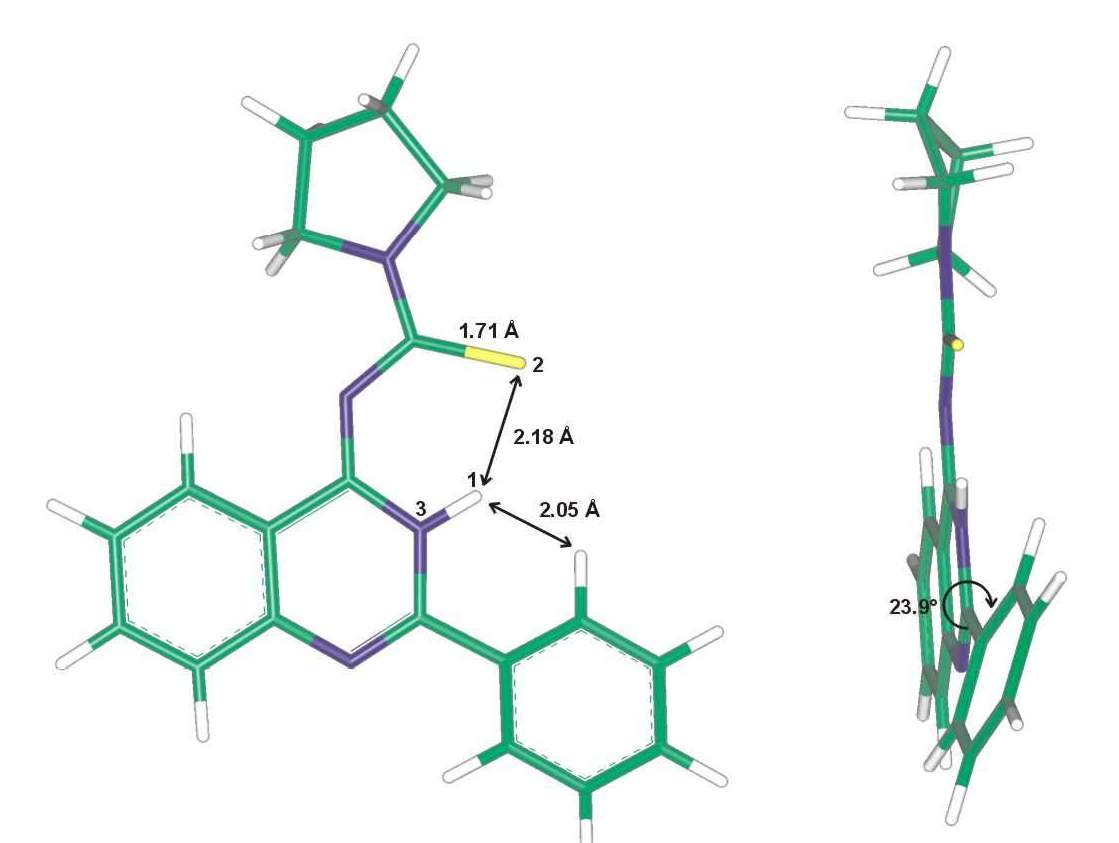
Figure 2. Molecular design of N3,N3-(butan-1,4-diyl)-N1-(2-phenyl-3,4-dihydroquinazolin-4-yliden)thiourea according to quantum computations.
The nucleophilic character present in this molecule generated from four resonance structures as shown in Scheme 2 and were concerted at N1, N3, N11 and S18 atoms.
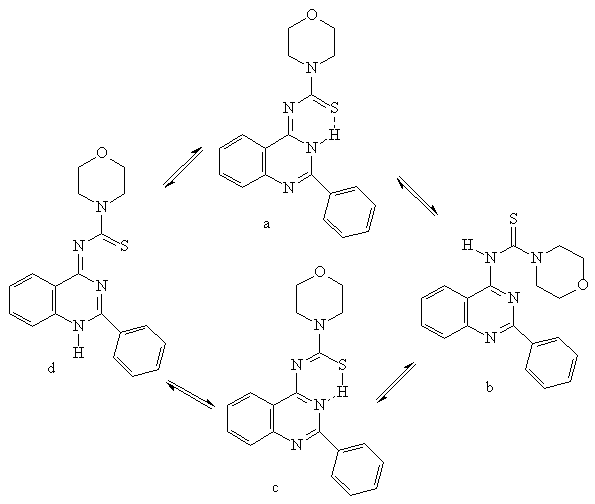
Scheme2. The possible tautomeric forms of N3,N3-(3-oxapentan-1,5-diyl)-N1-(2-phenyl-3,4-dihydro-quinazolin-4-yliden)thiourea 1.
4. DFT computational calculations
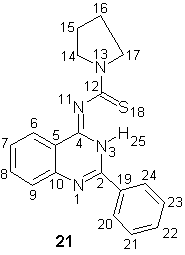
Figure 3. Numbering of
N3,N3-(butan-1,4-diyl)-N1-(2-phenyl-3,4-dihydroquinazolin-4-yliden)thiourea
|
|
|
|
| ||
|
|
|
|
| ||
| N1 |
-0.661395 |
-0.869053 |
C14 |
-0.070110 |
0.114214 |
| C2 |
0.674738 |
0.840738 |
C15 |
-0.356036 |
-0.192301 |
| N3 |
-0.957525 |
-0.919923 |
C16 |
-0.356683 |
0.036865 |
| C4 |
0.818582 |
1.163949 |
C17 |
-0.082609 |
0.026630 |
| C5 |
-0.138470 |
-0.751552 |
S18 |
-0.407139 |
-0.526777 |
| C6 |
-0.156366 |
0.145400 |
C19 |
-0.060789 |
-0.120287 |
| C7 |
-0.224384 |
-0.315348 |
C20 |
-0.174822 |
-0.091611 |
| C8 |
-0.179581 |
0.018493 |
C21 |
-0.209759 |
-0.161769 |
| C9 |
-0.216206 |
-0.457702 |
C22 |
-0.184715 |
-0.093411 |
| C10 |
0.288336 |
0.877833 |
C23 |
-0.211563 |
-0.170552 |
| N11 |
-0.757558 |
-0.680820 |
C24 |
-0.215089 |
-0.086336 |
| C12 |
0.484176 |
0.218205 |
H25 |
0.465862 |
0.380537 |
| N13 |
-0.642266 |
0.026039 |
|||
Table 1. The partial charge values of selected atoms in the
anion form
N3,N3-(butan-1,4-diyl)-N1-(2-phenyl-3,4-dihydroquinazolin-4-yliden)thiourea.
|
|
|
|
| ||
|
|
|
|
| ||
| N1
(2pz) |
-0.20733 |
0.14810 |
N13
(2pz) |
0.00612 |
0.14293 |
| N3
(2pz) |
0.07979 |
-0.13692 |
S18
(2pz) (3pz) |
-0.10544
0.27435 |
-0.05194
0.13778 |
| N11
(2pz) |
-0.18972 |
-0.10160 |
|||
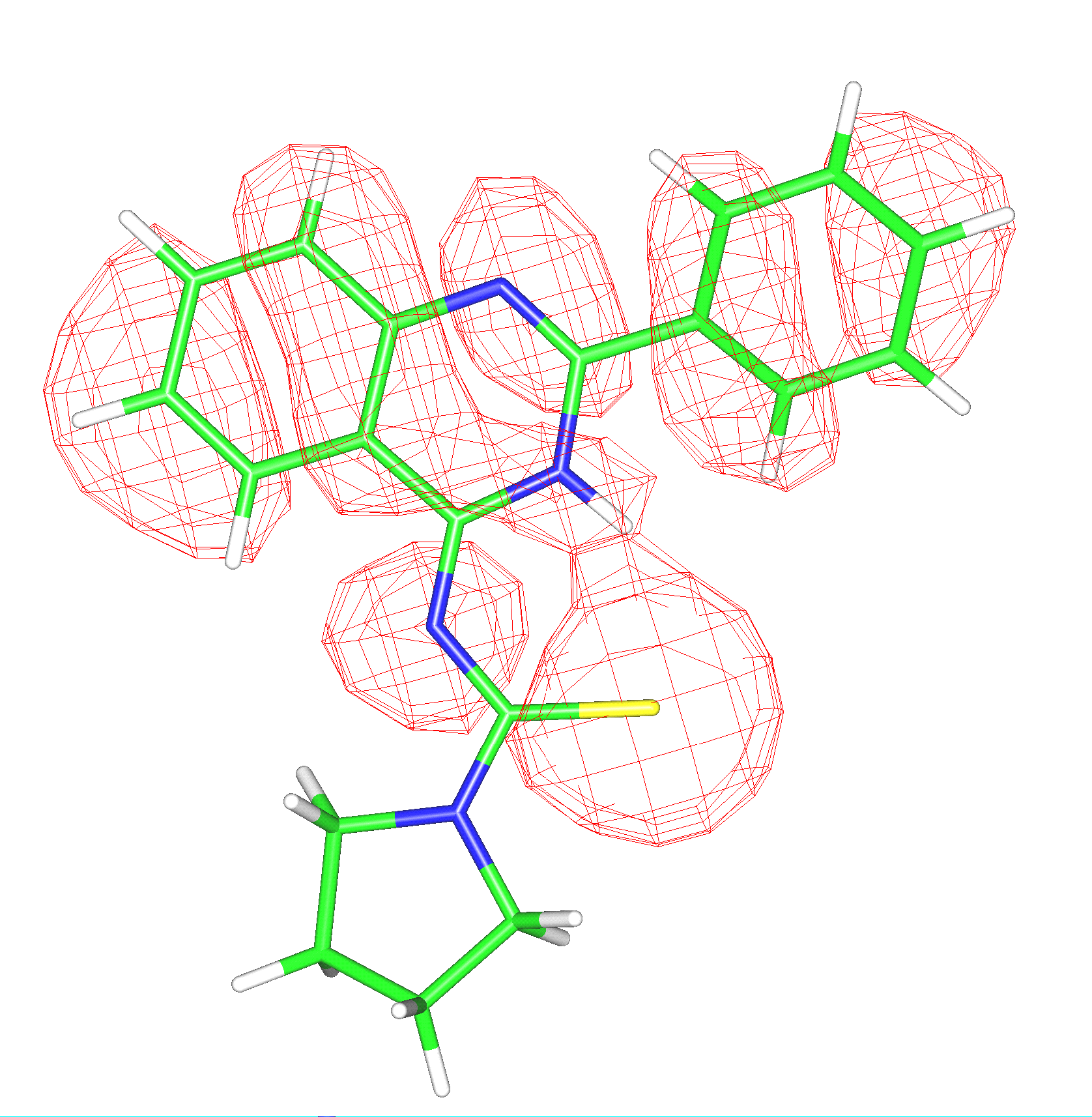
Figure 4. HOMO graphical representation of the anion form of N3,N3-(butan-1,4-diyl)-N1-(2-phenyl-3,4-dihydroquinazolin-4-yliden)thiourea.
The following characteristics were obtained from the DFT computational analysis together with the X-ray structure analysis, expected tautomeric forms and the chemistry of thioamides:
 The sulfur atom S18
has a larger HOMO coefficient c2 value than that on the nitrogen
atoms N2, N3 and N11.
The partial charge
distributed on the nitrogen atom N3 is larger than that on the other competing
nucleophilic active sites N1, S18 and N11.
The sulfur atom S18
has a larger HOMO coefficient c2 value than that on the nitrogen
atoms N2, N3 and N11.
The partial charge
distributed on the nitrogen atom N3 is larger than that on the other competing
nucleophilic active sites N1, S18 and N11.
The reactions of
compound 1 with electrophiles were expected to give either the
N3-substituted products [3,4] via strong Coulombic attraction with
electrophiles having large charge content, or the S-substituted product
via orbital-orbital interactions.
A residual bond order
determined between the H-25 and S-18 atoms show the hydrogen bond interaction
between them, which play an important role in the stability and reaction of the
model compound 1.
The model compound
1 is almost planar having the phenyl ring at position 2 slightly out of
plane Figure 2.
The model compound
1 contains three active electrophilic sites, which represented by C2, C4,
and C12. The expected electrophilic activity would refer to C12 due to stability
of the compound.
The reaction of N3,N3-(3-oxapentan-1,5-diyl)-N1-(2-phenyl-3,4-dihydro-quinazolin-4-yliden)thiourea 1 with amines gave the N3,N3-di-R-N1-(2-phenyl-3,4-dihydroquinazolin-4-yliden)thioureas 2 and N3-R-N1-(2-phenylquinazolin-4-yl)thioureas 3 via transamination reactions (Scheme 3). These compounds were previously prepared by the reaction of N-(2-cyanophenyl)benzimidoyl isothiocyanate i with amines [1,2]. The above-mentioned reactions show the role of hydrogen bond in the stability of isolated products and gave evidence for the tautomeric interconversion of compound 1 as represented (Scheme 2). The reaction proceeds by the addition of amines at the thiocarbonyl carbon C12 followed by the elimination of the morpholino moiety to finally afford the most stable defined products 2 (secondary amine application) [1] or 3 (primary amine and aniline applications) [2].
The model compound 1 reacts with equimolar amount of aniline to afford N3-Ar-N1-(2-phenylquinazolin-4-yl)thioureas 3.The reaction was extended to give the symmetrical diphenylthiourea 4 and 4-amino-2-phenylquinazoline 5 by addition of an extra mole of aniline (Scheme 3). The reaction proceeds in a similar manner to the former reaction to afford the quinazoline derivative 3, next the extra mole of aniline attacks the thiocarbonyl group and consequently the elimination of the 4-amino-2-phenylquinazoline 5 (Scheme 3).
The N4-di-R-N'4-(2-phenylquinazolin-4-yl)morpholin-4-carboximidamide 6 (guanidine derivatives) were prepared by the oxidative desulfurization reaction of 1 with amines in the presence of hydrogen peroxide. The guanidine derivatives 6 were also provided by a first step reaction of 1 with benzyl chloride to afford 4-benzyl-N4-(2-phenylquinazolin-4-yl)morpholin-4-carboximidothioate 7 (R= CH2Ph) (S-alkyl product) followed by the addition reaction of amines at the isothiourea carbon C12 to finally give 6 (Scheme 4).
The above-mentioned reactions represent the electrophilic character of the model N3,N3-(3-oxapentan-1,5-diyl)-N1-(2-phenyl-3,4-dihydro-quinazolin-4-yliden)thiourea 1.
The morpholinoquinazoline 1 as mentioned above react with simple alkyl halides to give the 4-alkyl-N4-(2-phenylquinazolin-4-yl)morpholine-4-carboximidothioate 7 (R= methyl, benzyl, allyl). The regioselective S-substitution reaction is favored due to orbital-orbital interactions between the LUMO of the electrophile and the higher HOMO of the ambident nucleophile 1 to produce the S-attack [3,4]. This fact is supported by the DFT computational calculations (Section 4).
The model compound 1 was expected to give N3-alkyl products 8 (R= CH2CH2R`) via large Coulombic attractions by the reaction with hard electrophiles (acrylic acid derivatives) [4], however no products were observed (Scheme 4).
The reaction of 1 with amines and formaldehyde under Mannich reaction conditions [4] was expected to give N3-alkyl products 8 (R= CH2NRR`), however the reaction favored the transamination reaction to give N3,N3-di-R-N1-(2-phenyl-3,4-dihydroquinazolin-4-yliden)thioureas 2 [1] and N3-R-N1-(2-phenylquinazolin-4-yl)thioureas 3 (Scheme 3).
Morpholinoquinazoline 1 react with alkyl halides containing activated methylene group to provide a complicated but interesting reactions this is due to the involvement of more than one nucleophilic character and more than one electrophilic character in a spontaneous multi-step reaction. These reactions are going to be discussed in details in [5].
6. Structure elucidation
The 1H-NMR and 13C-NMR of all examined compounds 1-7 show great similarity to the simulated computer spectra.
Compounds 1-3 were confirmed by the comparison of 1H-NMR, 13C-NMR, mass and I.R spectra with standard samplesof completely identified structures and prepared from different precursors [1,2]. The 1H-NMR spectra of these compounds show an important peak at ca. 16 ppm corresponding to the NH group of the quinazoline derivative 1, 2, which confirms together with X-ray analysis the hydrogen bond interactions between the thiocarbonyl group and the hydrogen of the NH group CS…HN3 (secondary amine applications). On the other hand the 1H-NMR spectra for 3 (primary amine application) gave a peak at ca 12 ppm and a peak at ca. 14 ppm (anilines application) corresponding to the NH group, which confirms together with X-ray analysis the hydrogen bond interactions between the N3 and the hydrogen atom of the NHAr group N3…HN13. The mass spectra gave the molecular ion for all the examined products 1-3.
The above-mentioned tools represent chosen important characters for the structure elucidation.
Compound 6 were confirmed by the disappearance of (C=S) peak in 13C-NMR spectrum, also it gave and additional peaks from the pyrrolidine ring at ca 49.31 and 25.61 ppm. Mass spectra gave the molecular ion peak 387 (NRR= pyrrolidine). The 1H-NMR spectrum shows the disappearance of NH peak at ca 16.5 ppm and gave additional peaks from the pyrrolidine ring at ca 3.2 and 1.9 ppm.
The 1H-NMR and 13C-NMR 7 gave sufficient evidence for the S-contribution. The 1H-NMR spectrum shows SCH2 at ca 3.23 ppm (R= allyl), while the same group appears at 36.51 ppm in the 13C-NMR spectrum. The 13C-NMR spectrum also shows the disappearance of (C=S) peak present in 1. The N-substituted products 8 would give higher chemical shifts according to the simulating computer spectra and to references [3,4].
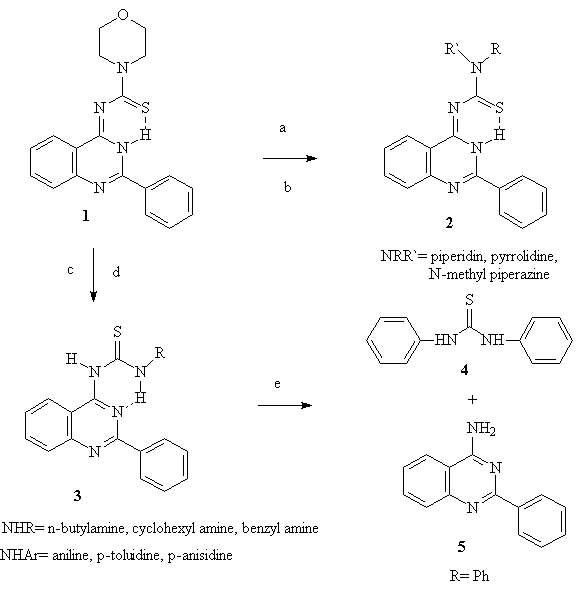
a: HNRR, DMF, 80° C, 5-6h. b: HNRR, DMF, CH2O 80° C, 5-6h.
c: H2NR, DMF, 80° C, 5-6h. d: H2NR, DMF, CH2O 80° C, 5-6h.
e: aniline, DMF, 80° C, 5-6h.
Scheme 3. Concurrent reactivity of N3,N3-(3-oxapentan-1,5-diyl)-N1-(2-phenyl-3,4-dihydro-quinazolin-4-yliden)thiourea.
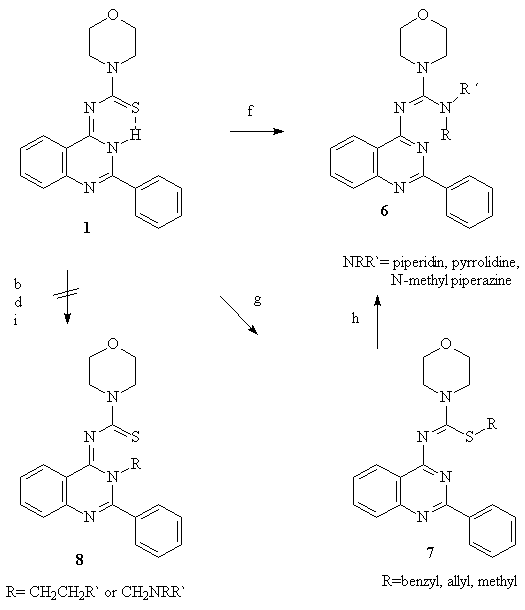
b: HNRR, DMF, CH2O 80° C, 5-6h d: H2NR, DMF, CH2O, 80° C, 5-6h.
f: XR, DMF, NEt3 25° C, 3h. g: HNRR´, H2O2, 25° C,2-24h
h:HNRR, DMF, 80° C, 5-6h. i:CH2=CHR, DMF, NEt3, 80° C, 5-6h.
Scheme 4. Concurrent reactivity of N3,N3-(3-oxapentan-1,5-diyl)-N1-(2-phenyl-3,4-dihydro-quinazolin-4-yliden)thiourea.
7. Conclusions
The thioamide represented by the model compound N3,N3-(3-oxapentan-1,5-diyl)-N1-(2-phenyl-3,4-dihydro-quinazolin-4-yliden)thiourea contain both multi-functional nucleophilic and electrophilic characters.
It reacts regioselectivity with amines, amines in the presence of
H2O2 and alkyl halides to give the transamination reaction
products 2, 3, the oxidative desulfurization guanidine products
6 and the S-alkyl product 7, respectively.
8. Acknowledgments
This work was supported by a grant from the Ministry of Education of the Czech Republic (Grant No. CEZ: J07/98:143100011) and from the Grant Agency of the Czech Republic (Grant No. 203/01/1333). The authors wish to thank the Academic Supercomputer Center in Brno for providing access to computer facilities.
9. REFERENCES