Fifth International Electronic Conference on Synthetic Organic Chemistry (ECSOC-5), http://www.mdpi.org/ecsoc-5.htm, 1-30 September 2001
[C0020]
Combinatorial Modification of Natural Product Derived Steroids
Christoph M. Huwe,* Hermann Künzer and Cornelia Schlicht
Schering AG, Medicinal Chemistry Department,
Research Center Europe, 13342 Berlin, Germany,
Phone: (+4930) 468-17226,
Fax: (+4930) 468-97226, E-Mail: [email protected]
Received: 15 August 2001 / Uploaded 22 August 2001
Abstract: Starting from b-sitosterol, a regrowing steroid source, a model library of steroidal ureas was synthesized by means of microbiological as well as solution-phase and solid-phase chemical transformations utilizing a thioketal linker derived from (±)-a-lipoic acid.
Steroids are important pharmacologically active
scaffolds. Herein we describe the application of our lipoic acid derived
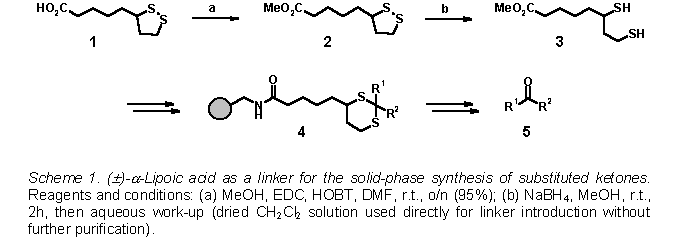
thioketal linker1 (Scheme 1) to the solid-phase synthesis of
D4-3-keto steroidal
ureas from b-sitosterol, a
regrowing steroid source.
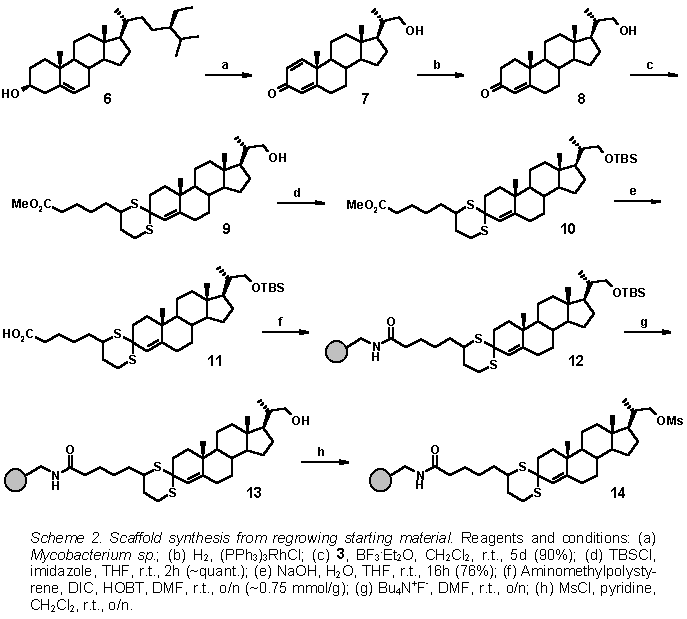
The phytosterol b-sitosterol (6) is easily available
from soy beans. This compound was subjected to microbiological oxidation
(mycobacterium sp.) yielding D1,4-3-keto intermediate 7, followed by selective
hydrogenation (Wilkinson's catalyst) to give D4-3-keto compound 8,
which was chosen as the scaffold for the model library described herein.
Introduction of our thioketal linker (dithiol 3,
BF3.Et2O, CH2Cl2, r.t.,
5d, 90%; see Scheme 1), protection of the hydroxyl group of 9 as a
TBS ether (TBSCl, imidazole, THF, r.t., 2h, ~quant.) and selective hydrolysis of
the methyl ester of 10 (NaOH, H2O, THF, r.t., 16h, 76%) gave
carboxylic acid intermediate 11, ready to be attached to the solid
support. Immobilization of 11 utilizing commercially available
aminomethylated polystyrene resin2 (DIC, HOBT, DMF, r.t., o/n) could
easily be tracked by means of solid-phase IR spectroscopy (KBr, ~1660
cm-1) and yielded material with a resin loading of ~0.75
mmol/g.3 Removal of the silyl protecting group of 12
(Bu4N+F-, DMF, r.t., o/n, IR ~3410
cm-1), and activation of the resulting hydroxyl group of 13 as
a mesylate (MsCl, pyridine, CH2Cl2, r.t., o/n, IR ~1175
cm-1) gave intermediate 14, ready for diversification (see
Scheme 3).
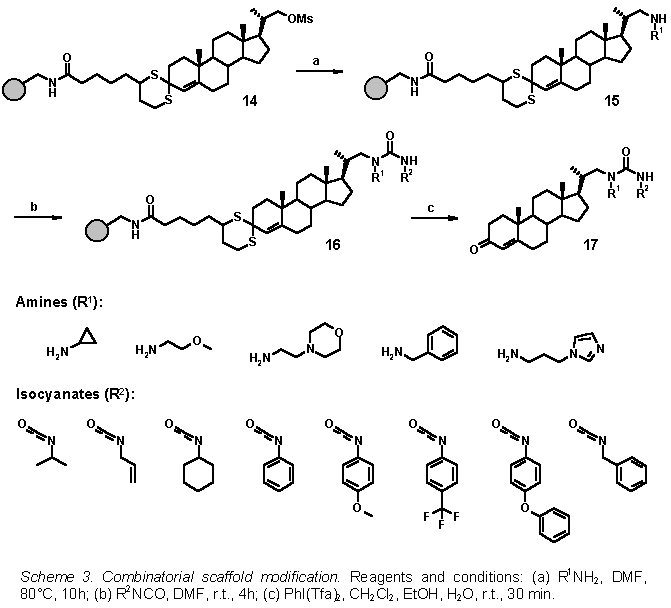
This material (14) was then distributed
into 40 reactors of an automated synthesizer4 and, in the sense of a
matrix synthesis, sequentially treated with a set of 5 primary amines
(R1NH2, NaI, DMF, 80°C, 10h) to give immobilized secondary
amines 15, and a set of 8 isocyanates (R2NCO, DMF, r.t., 4h)
to generate a 5x8 matrix of 40 immobilized steroidal ureas 16 (see
Scheme 3). Cleavage of the products from the solid support
(PhI(Tfa)2, CH2Cl2, EtOH, H2O, r.t.,
30 min.),5 followed by aqueous work-up finally gave the desired
compounds 17 in ~10% average isolated overall yield.6
In summary, we have utilized microbiological as
well as solution-phase and solid-phase chemical transformations to generate a
model library of steroidal ureas starting from the regrowing steroid source
b-sitosterol using our
(±)-a-lipoic acid based thioketal linker
system.
References and Notes
1. Huwe, C.M.; Künzer, H. Tetrahedron
Lett. 1999, 40, 683.
2.
Aminomethylated polystyrene resin was obtained from Rapp Polymere GmbH,
Germany.
3. The polymer loading was determined
gravimetrically, i.e., calculated from the observed change of resin
mass.
4. A Chemspeed ASW2000
synthesizer by Chemspeed Ltd., Switzerland, was used.
5. For details about linker synthesis and cleavage see ref.
1.
6. Yields were determined gravimetrically,
products were characterized by HPLC-MS.