Sixth International Electronic Conference on Synthetic Organic
Chemistry (ECSOC-6), http://www.mdpi.org/ecsoc-6, 1-30 September
2002
[C004]
Substituted pyrazine-2-carboxamides, their synthesis and
photosynthesis-inhibiting activity
Martin Dolezal1a*, Helena
Kutilova1, Katarina Kralova2, Jiri
Kunes3
1 Department of
Pharmaceutical Chemistry and Drug Control, Faculty of Pharmacy, Charles
University, 500 05 Hradec Kralove, Czech Republic
a e-mail: [email protected], tel. +420 49
5067272, fax +420 49 5512423
2 Institute of Chemistry, Faculty of
Natural Sciences, Comenius University, 842 15 Bratislava, Slovak
Republic
3 Department of Inorganic and Organic Chemistry, Faculty
of Pharmacy, Charles University, 500 05 Hradec Kralove, Czech Republic
*
Author to whom correspondence should be addressed.
Received: /
Uploaded:
Abstract: Condensation of chlorides of substituted pyrazine-2-carboxylic
acids with ring-substituted anilines yielded a series of amides of
6-chloropyrazine-2-carboxylic, 5-tert-butylpyrazine-2-carboxylic or
5-tert-butyl-6-chloro-pyrazine-2-carboxylic acids. Products were tested for
their photosynthesis-inhibiting activity. The most active inhibitor of oxygen
evolution rate in spinach chloroplasts was
5-tert-butyl-6-chloro-pyrazine-2-carboxylic acid
(5-bromo-2-hydroxy-phenyl)-amide (IC50 = 0.0419 mmol
dm-3). The presence of phenolic group in the benzene moiety
determined to an increased photosynthesis-inhibitory
activity.
Keywords: Amides of
5-alkyl-6-chloro-pyrazine-2-carboxylic acids; Photosynthesis inhibition; Spinach
chloroplasts
Introduction
Various compounds possessing -NHCO- group were
found to inhibit photosynthetic electron transport [1—4]. Amides of
2-alkylpyridine-4-carboxylic [5,6], 2-alkylsulfanylpyridine-4-carboxylic
[6,7] acids inhibited oxygen evolution rate in Chlorella vulgaris
and their inhibitory activity depended on the lipophilicity of the compounds.
Several esters of alkoxy substituted phenylcarbamic acids showed the antialgal
activity against Chlorella vulgaris [8—10]. We have recently
reported the synthesis of a series of amides prepared from the substituted
pyrazine-2-carboxylic acids and some aminophenols [11], halogenated and
alkylated anilines [12—15]. All these amides possess some antialgal,
antifungal, and antimycobacterial properties [12,14,16].
The
presented study is concerned in the synthesis of another series of amides
prepared via anilinolysis of substituted pyrazin-2-carboxylic acid
chlorides with alkoxylated, hydroxylated and/or halogenated anilines. The aim of
this work is to search for the structure—activity relationships in the mentioned
series, i.e. to continue in studying of the substituent variability
influence on the biological activity, and to determine the importance of
increased hydrophobic properties for photosynthesis-inhibiting evaluation of
newly prepared substituted pyrazine-2-carboxamides.
Results and
Discussion
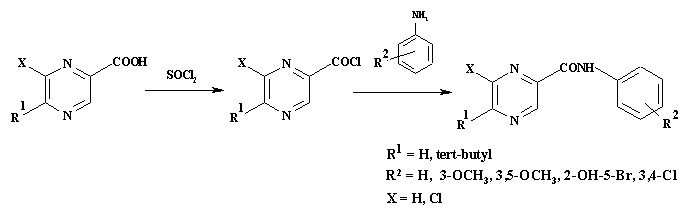
The synthesis of amides is shown in Scheme 1. Condensation
of chlorides of 6-chloropyrazine-2-carboxylic (1a) [17],
5-(1,1-dimethylethyl)pyrazine-2-carboxylic (1b) [11] or
6-chloro-5-(1,1-dimethylethyl)pyrazine-2-carboxylic (1c) [11]
acids with ring-substituted anilines yielded a series of 12 amides of mentioned
pyrazine-2-carboxylic acids 2a—l. The melting points, yields, elemental
analyses, and the IR, 1H and 13C NMR spectral data for the
all compounds prepared are given in Experimental. Calculated log P values
of all derivatives studied are shown in Table 1.
Twelve studied compounds
inhibited photosynthetic electron transport in spinach chloroplasts (see Table
1). The inhibitory activity of the studied compounds was relatively low, the
most efficient inhibitors were compounds 2h (IC50 = 80.3 µmol
dm-3) and mainly 2i (IC50 = 41.9 µmol
dm-3), i.e. compounds with the hydroxylic group on the benzene
ring (R2 = 2-OH-5-Br). These results are in the good correspondence
with our previous observation about the importance of phenolic moiety for the
photosynthesis-inhibiting activity in the studied compound type [11]. The
increased hydrophobic parameters of studied compounds possess only secondary
influence on the biological effect.
The addition of diphenylcarbazide (an
artificial electron donor acting in the intermediate Z+/D+
on the donor side of photo system II [18]) to spinach chloroplasts
inhibited by the studied compounds caused complete restoration of the
photosynthetic electron transport. This indicates that the primary donor of PS
II (P680) was not be damaged by the studied compounds. Previous EPR experiments
with some amides of pyrazin-2-carboxylic acid showed that the site of action of
these compounds in the photosynthetic apparatus of spinach chloroplasts is
intermediate D2 on the donor side of photo system II
[19].
Scheme 1: Synthesis of some substituted
pyrazine-2-carboxamides 2a—l
Experimental
General
Melting
points were determined on a Kofler apparatus and are uncorrected. Elemental
analyses were obtained using an EA 1110 CE instrument (Fisons Instruments
S.p.A., Milan). The IR spectra were recorded on a Nicolet Impact 400
spectrometer in KBr pellets. The 1H NMR spectra were measured for
solutions in CDCl3 with a Varian Mercury - Vx BB 300 spectrometer
operating at 300 MHz. Chemical shifts were recorded as δ values in parts per
million (ppm), and were indirectly referenced to tetramethylsilane via the
solvent signal (7.26 for 1H). Multiplicities are given together with
the coupling constants (in Hz). Log P values were computed using a
program ACD/LogP ver. 1.0 (Advanced Chemistry Development Inc.,
Toronto).
Synthesis of amides 2a—l
A mixture of acid
(i.e. 6-chloropyrazine-2-carboxylic [17],
5-tert-butylpyrazine-2-carboxylic [11] or
5-tert-butyl-6-chloro-pyrazine-2-carboxylic [11] acids, 0.05 mol) and
thionyl chloride (5.5 cm3, 75 mmol) in 20 cm3 of dry
benzene was refluxed for about 1 h. Excess of thionyl chloride was removed by
repeated evaporation with dry benzene in vacuo. The crude acyl chloride
dissolved in 50 cm3 of dry acetone was added drop wise to a stirred
solution of the corresponding substituted aniline (50 mmol) in 50 cm3
of dry pyridine keeping at the room temperature. After the addition was
complete, stirring continued for another 30 min. The reaction mixture was then
poured into 100 cm3 of cold water and the crude amide was collected
and recrystallized from aqueous
ethanol.
6-Chloro-pyrazine-2-carboxylic acid
(3-methoxy-phenyl)-amide (2a). Appropriate aniline afforded 2a
in 74% yield, m.p. 139-140 °C. For
C12H10ClN3O2 (263.7) calculated:
54.66% C, 3.62% H, 13.45% Cl, 15.94% N; found: 54.72% C, 3.59% H, 16.09% N. IR
spectrum: 3355 (NH), 2838 (OCH3), 1681 (CO). 1H NMR (300
MHz, CDCl3) δ 9.39-9.37 (m, 2H, H3, NH), 8.80 (d, 1H, J=0.55 Hz, H5),
7.50 (t, 1H, J=2.20 Hz, H2'), 7.30 (d, 1H, J=7.96 Hz, H4'), 7.24-7.19 (m, 1H,
H5'), 6.74 (ddd, 1H, J=7.96 Hz, J=2.47 Hz, J=1.10 Hz, H6'), 3.84 (s, 3H,
OCH3). 13C NMR (75 MHz, CDCl3) δ 160.2, 159.3,
147.5, 147.4, 143.9, 142.2, 138.0, 129.9, 112.2, 111.1, 105.5,
55.4.
5-tert-Butyl-pyrazine-2-carboxylic acid
(3-methoxy-phenyl)-amide (2b). Appropriate aniline afforded 2b
in 81% yield, m.p. 79-80 °C. For
C16H19N3O2 (285.4) calculated:
67.35% C, 6.71% H, 14.73% N; found: 67.48% C, 6.69% H, 14.95% N. IR spectrum:
3360 (NH), 2841 (OCH3), 1677 (CO). 1H NMR (300 MHz,
CDCl3) δ 9.65 (bs, 1H, NH), 9.39 (d, 1H, J=1.37 Hz, H3), 8.62 (d, 1H,
J=1.37 Hz, H6), 7.55 (t, 1H, J=2.20 Hz, H2'), 7.28 (t, 1H, J=7.97 Hz, H5'),
7.22-7.17 (m, 1H, H4'), 6.72 (ddd, 1H, J=7.97 Hz, J=2.47 Hz, J=1.10 Hz, H6'),
3.85 (s, 3H, OCH3), 1.45 (s, 9H, CH3). 13C NMR
(75 MHz, CDCl3) δ 167.8, 161.1, 160.2, 142.9, 141.3, 1389.0, 138.6,
129.8, 111.9, 110.7, 105.2, 55.3, 37.0,
29.7.
5-tert-Butyl-6-chloro-pyrazine-2-carboxylic acid
(3-methoxy-phenyl)-amide (2c). Appropriate aniline afforded 2c
in 78% yield, m.p. 128-129 °C. For
C16H18ClN3O2 (319.8) calculated:
60.09% C, 5.67% H, 11.09% Cl, 13.14% N; found: 59.88% C, 5.62% H, 13.18% N. IR
spectrum: 3380 (NH), 2840 (OCH3), 1686 (CO). 1H NMR and
13C NMR spectral data were not
obtained.
6-Chloro-pyrazine-2-carboxylic acid
(3,5-dimethoxy-phenyl)-amide (2d). Appropriate aniline afforded
2d in 64% yield, m.p. 211-212 °C. For
C13H12ClN3O3 (293.7) calculated:
53.16% C, 4.12% H, 12.07% Cl, 14.31% N; found: 52.81% C, 4.29% H, 14.02% N. IR
spectrum: 3370 (NH), 2964, 2838 (OCH3), 1685 (CO). 1H NMR
(300 MHz, CDCl3) δ 9.38 (s, 1H, H3), 9.34 (bs, 1H, NH), 8.81 (s, 1H,
H5), 6.98 (d, 2H, J=2.19 Hz, H2', H6'), 6.33-6.30 (m, 1H, H4'), 3.82 (s, 6H,
OCH3). 13C NMR (75 MHz, CDCl3) δ 161.2, 159.3,
147.6, 147.4, 143.9, 142.2, 138.5, 98.2, 97.7,
55.5
5-tert-Butyl-pyrazine-2-carboxylic acid
(3,5-dimethoxy-phenyl)-amide (2e). Appropriate aniline afforded
2d in 82% yield, m.p. 135-136 °C. For
C17H21N3O3 (315.4) calculated:
64.74% C, 6.71% H, 13.32% N; found: 63.85% C, 6.71% H, 13.23% N. IR spectrum:
3360 (NH), 2961, 2838 (OCH3), 1690 (CO). 1H NMR (300 MHz,
CDCl3) δ 9.62 (bs, 1H, NH), 9.38 (d, 1H, J=1.37 Hz, H3), 8.62 (d, 1H,
J=1.38 Hz, H6), 7.00 (d, 2H, J=2.20 Hz, H2', H6'), 6.29 (t, 1H, J=2.20 Hz, H4'),
3.82 (s, 6H, OCH3), 1.44 (s, 9H, CH3). 13C NMR
(75 MHz, CDCl3) δ 167.8, 161.1, 161.1, 142.9, 141.3, 139.1, 139.0,
97.9, 97.2, 55.4, 37.1,
29.7
5-tert-Butyl-6-chloropyrazine-2-carboxylic acid
(3,5-dimethoxy-phenyl)-amide (2f). Appropriate aniline afforded
2f in 49% yield, m.p. 123-124 °C. For
C17H20ClN3O3 (349.8) calculated:
58.37% C, 5.76% H, 10.13% Cl, 12.01% N; found: 58.57% C, 5.91% H, 12.05% N. IR
spectrum: 3376 (NH), 2960, 2839 (OCH3), 1698 (CO). 1H NMR
(300 MHz, CDCl3) δ 9.31 (bs, 1H, NH), 9.25 (s, 1H, H3), 6.99 (d, 2H,
J=2.20 Hz, H2', H6'), 6.30 (t, 1H, J=2.20 Hz, H4'), 3.82 (s, 6H,
OCH3), 1.55 (s, 9H, CH3). 13C NMR (75 MHz,
CDCl3) δ 164.6, 161.1, 159.8, 145.7, 141.0, 140.2, 138.7, 98.1, 97.5,
55.4, 39.0, 28.3
6-Chloro-pyrazine-2-carboxylic acid
(5-bromo-2-hydroxy-phenyl)-amide (2g). Appropriate aniline afforded
2g in 71% yield, m.p. 154-155 °C. For
C11H7BrClN3O2 (328.6) calculated:
40.21% C, 2.15% H, 24.32% Br, 10.79% Cl, 12.79% N; found: 40.51% C, 1.93% H,
13.05% N. IR spectrum: 3370 (NH), 1682 (CO). 1H NMR and
13C NMR spectral data were not
obtained.
5-tert-Butyl-pyrazine-2-carboxylic acid
(5-bromo-2-hydroxy-phenyl)-amide (2h). Appropriate aniline afforded
2h in 86% yield, m.p. 184-185 °C. For
C15H16BrN3O2 (350.2) calculated:
51.44% C, 4.60% H, 22.82% Br, 12.00% N; found: 51.39% C, 5.61% H, 11.94% N. IR
spectrum: 3368 (NH), 1685 (CO). 1H NMR (300 MHz, CDCl3) δ
9.55 (bs, 1H, NH), 9.37 (d, 1H, J=1.1 Hz, H3), 8.60 (d, 1H, J=1.1 Hz, H6), 8.08
(d, 1H, J=2.47 Hz, H3'), 7.47 (dd, 1H, J=8.79 Hz, J=2.47 Hz, H5'), 7.02 (d, 1H,
J=8.79 Hz, H6'), 5.66 (bs, 1H, OH), 1.44 (s, 9H, CH3). 13C
NMR (75 MHz, CDCl3) δ 167.9, 161.0, 149.4, 142.9, 141.1, 139.0,
131.2, 123.6, 120.9, 116.1, 110.1, 37.1,
29.7
5-tert-Butyl-6-chloro-pyrazine-2-carboxylic acid
(5-bromo-2-hydroxy-phenyl)-amide (2i). Appropriate aniline afforded
2i in 77% yield, m.p. 160-161 °C. For
C15H15BrClN3O2 (384.7) calculated:
46.84% C, 3.93% H, 20.77% Br, 9.22% Cl, 10.92% N; found: 47.09% C, 4.12% H,
11.13% N. IR spectrum: 3373 (NH), 1691 (CO). 1H NMR (300 MHz,
CDCl3) δ 9.28 (bs, 1H, NH), 9.25 (s, 1H, H3), 8.06 (d, 1H, J=2.47 Hz,
H3'), 7.49 (dd, 1H, J=8.79 Hz, J=2.47 Hz, H5'), 7.03 (d, 1H, J=8.79 Hz, H6'),
5.65 (bs, 1H, OH), 1.55 (s, 9H, CH3). 13C NMR (75 MHz,
CDCl3) δ 164.7, 159.7, 149.7, 145.8, 140.8, 140.2, 130.8, 123.8,
121.2, 116.1, 110.1, 39.0, 28.3
6-Chloro-pyrazine-2-carboxylic acid
(3,4-dichloro-phenyl)-amide (2j). Appropriate aniline afforded
2i in 83% yield, m.p. 132-133 °C. For
C11H6Cl2N3O (302.6) calculated:
43.67% C, 2.00% H, 35.15% Cl, 13.89% N; found: 43.51% C, 1.78% H, 14.11% N. IR
spectrum: 3370 (NH), 1690 (CO). 1H NMR (300 MHz, CDCl3) δ
9.41 (bs, 1H, NH), 9.38 (s, 1H, H3), 8.83 (s, 1H, H5), 8.00 (d, 1H, J=2.47 Hz,
H2'), 7.59 (dd, 1H, J=8.79 Hz, J=2.47 Hz, H6'), 7.45 (d, 1H, J=8.79 Hz, H5').
13C NMR (75 MHz, CDCl3) δ 159.3, 147.8, 147.4, 143.2,
142.1, 136.1, 132.9, 130.7, 130.6, 128.3, 121.5,
119.0
5-tert-Butyl-pyrazine-2-carboxylic acid
(3,4-dichloro-phenyl)-amide (2k). Appropriate aniline afforded
2k in 76% yield, m.p. 143-144 °C. For
C15H15Cl2N3O (324.2) calculated:
55.57% C, 4.66% H, 21.87% Cl, 12.96% N; found: 55.63% C, 4.71% H, 13.08% N. IR
spectrum: 3365 (NH), 1685 (CO). 1H NMR (300 MHz, CDCl3) δ
9.67 (bs, 1H, NH), 9.37 (d, 1H, J=1.37 Hz, H3), 8.61 (d, 1H, J=1.37 Hz, H6),
8.01 (d, 1H, J=2.48 Hz, H2'), 7.58 (dd, 1H, J=8.79 Hz, J=2.47 Hz, H6'), 7.43 (d,
1H, J=8.79 Hz, H5'), 1.45 (s, 9H, CH3). 13C NMR (75 MHz,
CDCl3) δ 168.2, 161.2, 143.0, 140.7, 139.0, 136.9, 133.0, 130.6,
127.7, 121.3, 118.9, 37.1,
29.7
5-tert-Butyl-6-Chloro-pyrazine-2-carboxylic acid
(3,4-dichloro-phenyl)-amide (2l). Appropriate aniline afforded
2l in 83% yield, m.p. 113-114 °C. For
C15H14Cl3N3O (358.7) calculated:
50.23% C, 3.93% H, 29.65% Cl, 11.72% N; found: 55.63% C, 4.71% H, 13.08% N. IR
spectrum: 3390 (NH), 1685 (CO). 1H NMR (300 MHz, CDCl3) δ
9.38 (bs, 1H, NH), 9.25 (s, 1H, H3), 8.01 (d, 1H, J=2.47 Hz, H2'), 7.59 (dd, 1H,
J=8.79 Hz, J=2.48 Hz, H6'), 7.44 (d, 1H, J=8.79 Hz, H5'), 1.55 (s, 9H,
CH3). 13C NMR (75 MHz, CDCl3) δ 165.1, 159.9,
145.8, 140.5, 140.3, 136.5, 133.0, 130.7, 128.2, 121.6, 119.1, 39.1,
28.2
Study of inhibition of oxygen evolution rate in spinach
chloroplasts
The inhibition of oxygen evolution rate (OER) in spinach
chloroplasts by the studied compounds was investigated spectrophotometrically
(Specord UV VIS, Zeiss, Jena) in the presence of an electron acceptor
2,6-dichlorophenol—indophenol, using method described in Ref. [20]. The
compounds were dissolved in dimethyl sulfoxide (DMSO) because of their low water
solubility. The used DMSO volume fractions (up to 5 vol. %) did not affect the
oxygen evolution. The inhibitory efficiency of the studied compounds has been
expressed by IC50 values, i.e. by molar concentration of the
compounds causing 50 % decrease in the oxygen evolution relative to the
untreated control. Comparable IC50 value for a selective herbicide
atrazine [21] is about 1.0 µmol dm-3.
Table 1:
OER inhibition in spinach chloroplasts (IC50) and calculated
lipophilicity (log P) of compounds 2a—l.
| Comp. |
IC50 [mmol dm-3] |
Log P |
| 2a |
0.4998 |
2.42 ± 0.42 |
| 2b |
0.7995 |
2.98 ± 0.41 |
| 2c |
0.6440 |
4.10 ± 0.43 |
| 2d |
0.5330 |
2.46 ± 0.43 |
| 2e |
0.3172 |
3.02 ± 0.42 |
| 2f |
0.4351 |
4.14 ± 0.45 |
| 2g |
0.1462 |
3.34 ± 0.50 |
| 2h |
0.0803 |
3.91 ± 0.49 |
| 2i |
0.0419 |
5.03 ± 0.51 |
| 2j |
0.1048 |
4.15 ± 0.44 |
| 2k |
1.5251 |
4.72 ± 0.43 |
| 2l |
0.1301 |
5.84 ± 0.45 |
| Atrazine |
0.0010 |
1.03 ± 0.62 |
Acknowledgements.
This study was supported by the Ministry of Education of the Czech Republic (No.
11160001) and by the Scientific Grant Agency of the Ministry of Education of the
Slovak Republic and the Slovak Academy of Sciences (Grant No. 1/7262/20). We
also thank D. Karlickova, J. Zizkova, and T. Vojtisek from the Faculty of
Pharmacy in Hradec Kralove, Charles University in Prague, Czech Republic, for
their skillful technical assistance and Dr. D. Mikulasova from the Department of
Biochemistry, Faculty of Natural Sciences, Comenius University, Bratislava,
Slovak Republic, for her assistance in the preparation of
chloroplasts.
References
- Good, N. E.: Plant. Physiol. 1961, 36, 788.
- Kralova, K., Sersen, F., Cizmarik, J.: Chem. Pap. 1992, 46,
266.
- Kralova, K., Sersen, F., Miletin, M., Hartl, J.: Chem. Pap. 1998,
52, 52.
- Kralova, K., Sersen, F., Kubicova, L., Waisser, K.: Chem. Pap.
1999, 53, 328.
- Miletin, M., Hartl, J., Machacek, M.: Collect. Czech. Chem. Commun.
1997, 62, 672.
- Kralova K., Loos D., Miletin M., Klimesova V.: Folia Pharm. Univ. Carol.
1998, 23 Suppl., 77.
- Miletin M., Dolezal M., Hartl J., Kralova K., Machacek M.: The Third
International Electronic Conference on Synthetic Organic Chemistry
(ECSOC-3), September 1-30, 1999 (http://www.unibas.ch/mdpi/ecsoc-3/c0005/c0005.htm).
- Kralova K., Loos D., Cizmarik J.: Collect. Czech. Chem. Commun.
1994, 59, 2293.
- Kralova K., Loos D., Cizmarik J.: Photosynthetica 1994, 30,
155.
- Kralova K., Bujdakova H., Cizmarik J.: Pharmazie 1995, 50,
440.
- Dolezal, M., Hartl, J., Miletin, M., Machacek, M., Kralova K.: Chem. Pap.
1999, 53, 126.
- Dolezal, M., Vicik, R., Miletin, M., Kralova, K.: Chem. Pap. 2000,
54, 245.
- Dolezal, M., Miletin, M., Hartl, J., Kralova, K., Kunes, J.: The Fourth
International Electronic Conference on Synthetic Organic Chemistry
(ECSOC-4), September 1-30, 2000 (http://www.unibas.ch/mdpi/ecsoc-4/c0028/c0028.htm).
- Dolezal, M., Hartl, J., Miletin, M.: Folia Pharm. Univ. Carol.
2000, 25, 15 (http://www.faf.cuni.cz/folia/25/2502dolezal.htm).
- Dolezal M., Miletin M., Hejsky R., Kralova K., Kunes J.: The Fifth
International Electronic Conference on Synthetic Organic Chemistry
(ECSOC-5), September 1-30, 2001 (http://www.mdpi.net/ecsoc-5/c0009/c0009.htm).
- Dolezal M., Miletin M., Kunes J., Kralova K.: Molecules 2002,
7, 363 (http://www.mdpi.net/molecules/papers/70300363.pdf).
- Abe, Y., Shigeta, Y., Uchimaru, F., Okada, S., Ozasayama, E.: Japan. 69
12,898 (1969); Chem. Abstr. 1969, 71, 112979y.
- Jegerschöld C. and Styring, S., FEBS Lett. 1991, 280,
87.
- Dolezal M., Kralova K., Sersen F., Miletin M.: Folia Pharm. Univ. Carol.
2001, 26, 13-20 (http://www.faf.cuni.cz/folia/26/2602dolezal.htm).
- Kralova, K., Sersen, F., Sidoova, E.: Chem. Pap. 1992, 46,
348.
- Carpentier, R., Fuerst, E. P., Nakatani, H. Y., Arntzen, C. J.: Biochim.
Biophys. Acta 1985, 808, 293.