 Introduction
Results and Discussion
Conclusion
References
8th International Electronic Conference on Synthetic Organic Chemistry. ECSOC-8. 1-30 November 2004. http://www.lugo.usc.es/~qoseijas/ECSOC-8/
Abstract: A new synthesis of esters of 2-oxo-1,2,3,4-tetrahydropyrimidine-5-carboxylic acids and some related compounds has been developed. The synthesis is based on reaction of a-tosyl-substituted phenyl carbamates with enolates of b-oxoesters or 1,3-dicarbonyl compounds followed by treatment of the obtained products with ammonia and dehydration of the resulting 4-hydroxyhexahydropyrimidin-2-ones.
Keywords: a-tosyl-substituted phenyl carbamates, b-oxoesters, 1,3-dicarbonyl compounds, 2-oxo-1,2,3,4-tetrahydropyrimidine-5-carboxylates, Biginelli compounds, 5-acyl-1,2,3,4-tetrahydropyrimidin-2-ones, 4-hydroxy-2-oxohexahydropyrimidine-5-carboxylates, 5-acyl-4-hydroxyhexahydropyrimidin-2-ones, ureides, 2-oxotetrahydro-1,3-oxazine-2-carboxylates
Introduction
Results and Discussion
Conclusion
References  Introduction
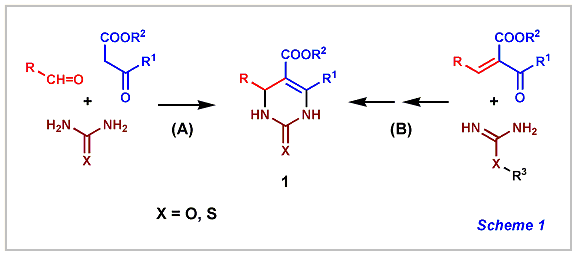
In recent years, there has been considerable interest in the synthesis of Biginelli compounds, namely esters of 2-oxo- and 2-thioxo-1,2,3,4-tetrahydropyrimidine-5-carboxylic acids (1) (for reviews see [1, 2]). It is mainly caused by diverse biological properties of these compounds. For example, they are active antihypertensive agents [3, 4], kinesin Eg5 inhibitors [5], alfa-1a adrenoceptor-selective antagonists [6], etc.
The one-step, three-component Biginelli condensation (A) [7, 8] and the multi-stage Atwal procedure (B) [9-11] are well-known synthetic methods providing access to the pyrimidines 1 (Scheme 1). A limitation of these methods is their low adaptability in obtaining some types of 1, especially those containing hydrogen atoms or an alkyl group at the forth position (R = H, alkyl).
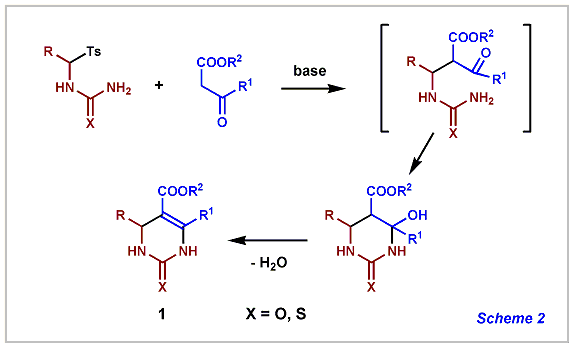
Recently [12, 13] we have developed a new general synthesis of compounds 1 based on the reaction of a-tosyl-substituted ureas or thioureas with enolates of b-oxoesters. Oxoalkyl(thio)ureas arisen as intermediates of this reaction undergo a spontaneous cyclization into the corresponding 4-hydroxyhexahydropyrimidin-2-ones/thiones. The latter are dehydrated to give Biginelli compounds (Scheme 2). This approach is free from many of the disadvantages of the literature procedures.
We have assumed that the oxoalkyl(thio)ureas can also be generated in the reaction of suitable (thio)carbamates containing an easily leaving group (for example, phenoxy group) with ammonia or primary amines. In this communication, preliminary results of this approach application to the synthesis of 1 and some related compounds are described.
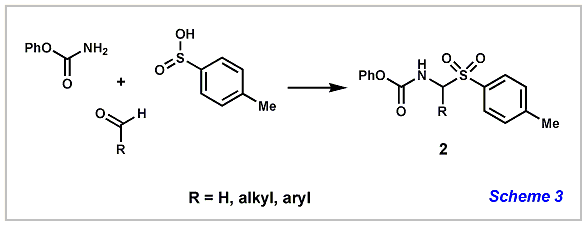
Results and DiscussionThe key starting compounds a-tosyl-substituted phenyl carbamates 2, were prepared by reaction of p-toluenesulfinic acid with various aldehydes and phenyl carbamate in water (Scheme 3). We found that this reaction proceeded at about 25 °C quite slowly (13-20 days). It can be probably explained by low solubility of the reagents and intermediate products in aqueous medium. However, the compounds 2 were obtained in excellent yields (91-96 %). The reaction time decreased with a rise in temperature. At 70 °C the reaction was completed in 10 h to provide 2 in 91-94 % yields.
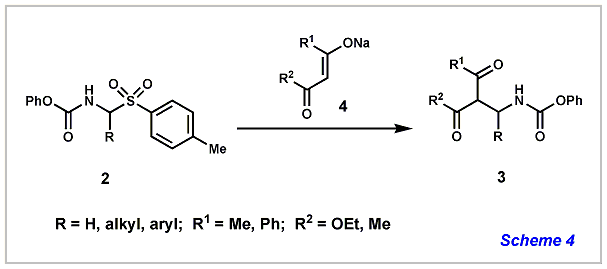
We established that the carbamates 2 readily reacted with sodium enolates of a-oxoesters or 1,3-dicarbonyl compounds (acetonitrile, r.t., 4-6 h) generated by treatment of the corresponding CH-acids with NaH in dry acetonitrile. As a result of this reaction, the products of nucleophilic substitution of the tosyl group in 2, namely the corresponding N-substituted phenyl carbamates 3, were produced in 74-93 % yields (Scheme 4).
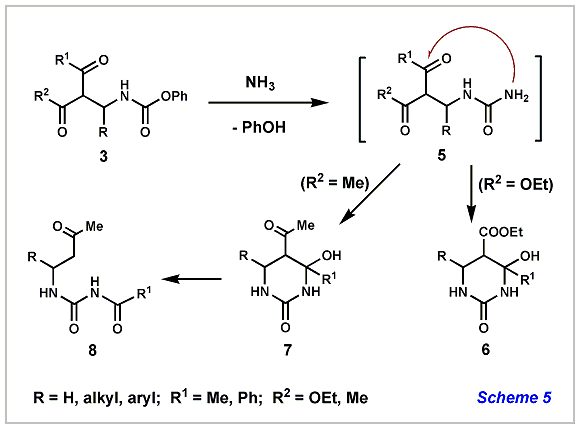
The phenoxy group in 3 was substituted for amino group by treatment of 3 with excess of ammonia in acetonitrile at room temperature. The reaction time depended on molar ratio of 3 to ammonia and was found to be approximately 24 h in a ratio of 1:13 or 5-6 h in a ratio of 1:60. The products of this reaction, ethyl 4-hydroxy-2-oxohexahydropyrimidine-5-carboxylates (6) and 4-hydroxyhexahydropyrimidin-2-ones (7), seem to be formed as a result of heterocyclisation of the intermediate oxoalkylureas (5) (Scheme 5). It should be noted that depending on conditions the reaction of 3 (R2 = Me) with ammonia led to 7 or to products of C(4)-C(5) bond cleavage in 7, namely ureides 8.
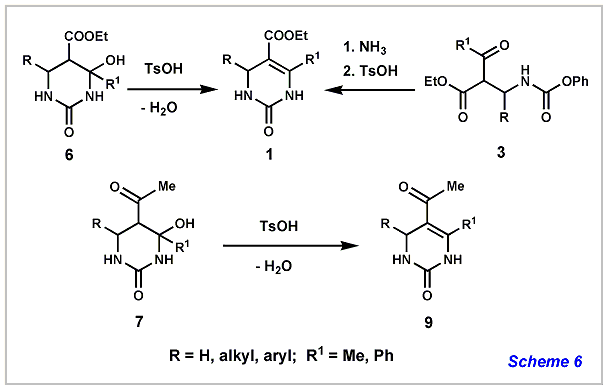
The hydroxypyrimidines 6 and 7 were dehydrated in the presence of TsOH to give Biginelli compounds 1 or 5-acetyl-1,2,3,4-tetrahydropyrimidin-2-ones 9. The synthesis of 1 was also performed directly from 3 without isolation of the intermediate 6 in 71-80 % overall yields (Scheme 6).
Phenyl carbamates 3 can be used as versatile precursors in syntheses of a large variety of heterocycles. For example, the reduction of 3 (R2 = OEt) with NaBH4 in ethanol led to ethyl 2-oxotetrahydro-1,3-oxazine-2-carboxylates (12 R3 = H) via hydroxyalkylcarbamates 10 (Scheme 7) .
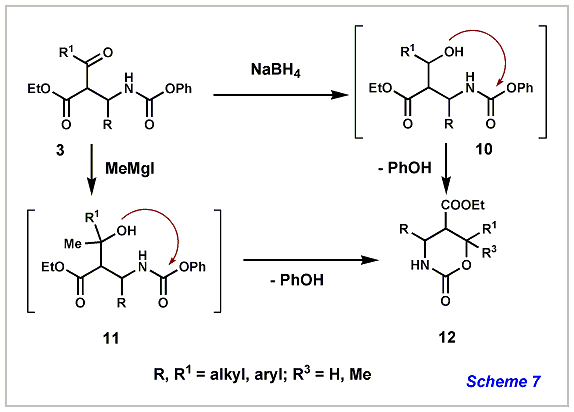
In a similar manner, the reaction of 3 with CH3MgI in ether gave tetrahydro-1,3-oxazines (12 R3 = Me) via hydroxyalkylcarbamates 11 (Scheme 7).
ConclusionWe have developed a new general three-stage method of the synthesis of Biginelli compounds. This method is characterized by rather high overall yields (up to 70 % based on phenyl carbamate) of the target products. In comparison with the known synthetic procedures (see Scheme 1), our approach is more flexible and allows a wide variety of substituents at N(1), C(4), C(5) and C(6) atoms of the pyrimidine ring. In particular, 4-alkyl substituted and 4-unsubstituted Biginelli compounds, as well as 1,2,3,4-tetrahydropyrimidin-2-ones bearing other functional groups at C(5) atom can be readily obtained according to the described method.
We have shown that our strategy can be applied to preparation of 5-functionalized 4-hydroxyhexahydropyrimidin-2-ones which are versatile precursors in syntheses of various heterocycles.
We have found that phenyl carbamates 3 can be used as starting compounds in a large variety of heterocyclic syntheses, e.g., in synthesis of 1,3-oxazines.
References
1. C.O. Kappe, Tetrahedron, 1993, 49, 6937.
2. C.O. Kappe, Acc. Chem. Res., 2000, 33, 879.
3. K.S. Atwal, B.N. Swanson, S.E. Unger, D.M. Floyd, S. Moreland, A. Hedberg and B.C. O’Reilly, J. Med. Chem., 1991, 34, 806.
4. G.J. Grover, S. Dzwonczyk, D.M. McMullen, D.E. Normandin, C.S. Parham, P.G. Sleph and S. Moreland, J. Cardiovasc. Pharmacol., 1995, 26, 289.
5. S.J. Haggarty, T.U. Mayer, D.T. Miyamoto, R. Fathi, R.W. King, T.J. Mitchison and S.L. Schreiber, Chem. Biol., 2000, 7, 275.
6. D. Nagarathnam, S.W. Miao, B. Lagu, G. Chiu, J. Fang, T.G.M. Dhar, J. Zhang, S. Tyagarajan, M.R. Marzabadi, F.Q. Zhang, W.C. Wong, W.Y. Sun, D. Tian, J.M. Wetzel, C. Forray, R.S.L. Chang, T.P. Broten, R.W. Ransom, T.W. Schorn, T.B. Chen, S.O’Malley, P. Kling, K. Schneck, R. Benedesky, C.M. Harrell, K.P. Vyas and C. Gluchowski, J. Med. Chem., 1999, 42, 4764.
7. P. Biginelli, Gazz. Chim. Ital., 1893, 23, 360.
8. K. Folkers, H. J. Harwood and T. B. Johnson, J. Amer. Chem. Soc., 1932, 54, 3751.
9. B.C. O’Reilly and K.S. Atwal, Heterocycles, 1987, 26, 1185.
10. K.S. Atwal, B.C.O’Reilly, J. Z. Gougoutas and M. F. Malley, Heterocycles, 1987, 26, 1189.
11. K.S. Atwal, G.C. Rovnyak, B.C.O’Reilly and J. Schwartz, J. Org. Chem., 1989, 54, 5898.
12. A.D. Shutalev and V.A. Kuksa, Khim. Geterotsicl. Soedin., 1995, 97 (Chem. Heterocycl. Compd., 1995, 31, 86).
13. A.D. Shutalev, E.A. Kishko, N.V. Sivova and A.Yu. Kuznetsov, Molecules, 1998, 3, 100.