8th International Electronic Conference on Synthetic Organic Chemistry. ECSOC-8. 1-30 November 2004. http://www.lugo.usc.es/~qoseijas/ECSOC-8/
[A030]
Use of arylantimony(III,V), bismuth(III) compounds and peroxides in cross-coupling reactions with alkenes
Alexey V. Gushchin, Dmitry V. Moiseev, Vera A. Morugova, Julia B. Malysheva,
Victor A. Dodonov
Organic Chemistry Department, Nizhny Novgorod State University, 23 Gagarin Avenue,
Nizhny Novgorod, 603950, Russian Federation
Tel.: +7-831-233-7865; fax: +7-831-265-8592; e-mail: [email protected]
Keywords: tetraphenylantimony(V) carboxylates; triphenylantimony; triphenylbismuth; peroxides; arylation; palladium, homo-coupling, cross-coupling.
Tetraphenylantimony(V) carboxylates, triphenylantimony, triphenylbismuth have been used in the Pd-catalyzed C-phenylation reaction of methyl acrylate in the presence of peroxides such as (PhCO2)2, t-BuOOH, H2O2 under mild conditions (20-50 °С). The peroxides promote a cascade participation of organoantimony compound to provide transfer of two or three phenyl groups with the formation of methylcinnamate as a sole product. Organobismuth compound gives methylcinnamate, biphenyl and benzene simultaneously.
1. Introduction
Organoantimony compounds have been used in organic synthesis either as reagents or as catalysts for a number of years [1]. They also have been used in the Pd-catalyzed reactions [2]. We have recently reported that triarylantimony dicarboxylates were efficient reagents in the Pd-catalyzed C‑arylation reaction of unsaturated compounds with involvement of two aryl groups [3]. Triarylstibines Ar3Sb can also be used as reagents in the C-arylation reaction via formation of Ar3Sb(OAc)2 in situ in the presence of peroxides [4]. Tetraphenylantimony derivatives Ph4SbX have shown lower activity in comparison with Ar3Sb(OAc)2. Only one phenyl group was involved in the C-phenylation reaction [5].
Organobismuth compounds are of current interest [6]. There are several examples of palladium-mediated conversation of a C-Bi bond to a C-C bond. The cross-coupling have been observed in the reaction of Ar3Bi with acyl chloride [7], aryl halides and triflates [8], allyl halides [9] and in the reaction of organobismuth dialkoxides with aryl or alkenyl triflates and aryl halides [10,11]. Pentavalent triarylbismuth compounds Ar3BiX2 (X = Hal, OAc) have been used in the palladium-catalysed cross-coupling reaction with hypervalent iodonium salts at room temperature [12]. In the works [7,13] the homo-coupling of organobismuth compounds have been studied. Triarylbismuth has been used in the carbonylation reaction as well [14]. In the work [15] arylation of vinyl epoxides, diol acetonides and diol carbonates has been done with both triarylbismuth(III) and triarylbismuth(V) dichloride or carbonate. Several types of organobismuth(III) compounds have been tested in the Heck-type reactions [16-18]. In the work [19] some bismuth ylides have been used to study a homo- and cross-coupling competition.
In the present work organic peroxides are used to increase an efficiency of organoantimony and organobismuth derivatives in the C-phenylation of alkenes.
2. Results and discussion
2.1. Ph4SbX + Peroxide system in the Pd-catalyzed C-phenylation reaction
We investigated a model C-phenylation reaction of methyl acrylate 1 with tetraphenylantimony hydroxide Ph4SbOH 2 (4:1) in AcOH in the presence of t-BuOOH 3 (1.2 equivalent per Sb compound) and 4 mol% Li2PdCl4. Ph4SbOH was selected for the following reasons. It is one of the most accessible compounds of this type and can easy give tetraphenylantimony acetate Ph4SbOAc 4 in AcOH solution (Scheme 1). Peroxide 3 is the best oxidant of Sb(III) derivatives [4]. Li2PdCl4 is the optimum precatalyst for the C-phenylation in the presence of peroxides [4]. Methyl acrylate 1 was taken in a molar excess to 2 (4:1), one molecule of 1 per one phenyl group of 2.

|
|

Scheme 1.
The C-phenylation reaction of 1 with the (2 + 3) system gives methyl cinnamate 5 (Scheme 1) in a 247% yield for 24 h (the yield being based on the initial organoantimony reagent, the yield of 100% corresponds to the transfer of only one phenyl group) (Table 1, entry 1). The yield of 5 is not changed significantly in the presence of an excess of 3 (Table 1, entries 2 and 3). In the absence of the peroxide the product yield is only 30% (Table 1, entry 5). An application of tetraphenylantimony propionate Ph4SbO2CEt 6 instead of 2 shows the same activity, the yield of 5 is 254% (Table 1, entry 4). The high yield of 5 corresponds to the transfer of three phenyl groups. However, in these conditions the complete transfer do not occur and the product yield do not exceed 260%.
Table 1.
Pd-catalyzed reaction of Ph4SbOH with methyl acrylate 1 in the presence of a peroxide: influence of the nature and the amount of the peroxide a
|
Entry |
Peroxide |
Ph4SbOH : Peroxide |
Yields of 5 (%) b |
|
1 |
t-BuOOH |
1 : 1.2 |
247 |
|
2 |
t-BuOOH |
1 : 1.5 |
257 |
|
3 |
t-BuOOH |
1 : 2 |
240 |
|
4 c |
t-BuOOH |
1 : 1.2 |
254 |
|
5 |
- |
- |
30 |
|
6 d |
(PhCO2)2 |
1 : 1.5 |
240 |
|
7 |
(PhCO2)2 |
1 : 1.5 |
300 |
|
8 e |
(PhCO2)2 |
1 : 1.5 |
300 |
a The reactions were performed in AcOH at 50 °С for 24 h, under air with ratio between 1, [Sb] and Li2PdCl4 of 4:1:0.04.
b Yields were determined by GLC, yield of 100% corresponds to involvement of one Ph-group.
c Ph4SbO2CEt was used as a phenylating agent.
d Reaction duration was 12 h.
e Ph4SbO2CEt was used as a phenylating agent and CH3CN was used as a solvent.
The substitution of 3 for benzoyl peroxide (PhCO2)2 7 gives rise to the yield of 5. It is 240% and 300% in the case of 12 h and 24 h duration of the reaction, respectively (Table 1, entries 6 and 7). This yield corresponds the full involvement of three phenyl groups of 2. It is known that peroxide 7 in contrast with 3 can oxidize Sb(III) into active Sb(V) without involvement of carboxylic acid [4,8]. This allows to use the new system based on tetraphenylantimony derivatives in a neutral solvent, e.g. CH3CN. However Ph4SbOH is nоt effective in acetonitryle where it gives mainly a homo-coupling product, namely, biphenyl [5]. Therefore, propionate 6 was used as a phenylating agent. The reaction of 1 with the (6 + 7) system (1:1.5) gives the yield of 5, as expected, in 300% (CH3CN, 50 °C, 24 h) (Table 1, entry 8). When 7 is heated in the absence of organoantimony compound under the same conditions the phenylated product 5 is not formed.
Thus, tetraphenylantimony derivatives can be effective cross-coupling agents. In the presence of (PhCO2)2 they phenylate methyl acrylate under mild conditions (50 °С) to provide a transfer of three phenyl groups. It was found that Ph4SbOH was the preferable agent in AcOH, and Ph4SbO2CEt - in CH3CN, respectively.
2.2. Mechanistic aspects of organoantimony(V) involvement in the Pd-catalyzed C-phenylation reaction
To understand the whole process of the tetraphenylantimony compounds participation in the investigated catalytic reaction we isolated three main stages, on each of which only one phenyl group is transferred. The catalytic cycle consists of consecutive redox reactions of Sb atom, which are caused by the presence of a peroxide and a palladium in the system.
2.2.1.Transfer of the first phenyl group
At the first stage of a catalytic cycle tetraphenylantimony carboxylate 4 reacts with the active Pd(0) species formed on the activation stage. As result, phenylpalladium intermediate 8 and Ph3Sb 9 are formed (Eq. 1). The intermediate 8 interacts with 1 to give the phenylation product 5 (Eq. 2). On this stage the yield of 5 could reach a value of 100%. In reality, in the absence of peroxide it is only 30% (Table 1, entry 5) because of the inhibiting effect of Ph3Sb [3].
|
|
(1) |
|
|
(2) |


2.2.2.Transfer of the second phenyl group
On the second stage the peroxide oxidizes 9 into an active pentavalent state [3,4]. The mechanism of the oxidation has been studied well [9,10]. Ph3Sb forms either triphenylantimony diacetate Ph3Sb(OAc)2 10 in AcOH solution in the presence of hydroperoxide 3 (Eq. 3) or triphenylantimony dibenzoate Ph3Sb(O2CPh)2 11 in CH3CN in the presence of benzoyl peroxide 9 (Eq. 4). The triphenylantimony dicarboxylates oxidize Pd(0) into PhPdOAc 8 (Eq. 5), which phenylates methyl acrylate due to equation 2.
|
|
(3) |
|
|
(4) |
|
|
(5) |



To prove the existing of reaction 5 we made a special investigation of the C‑arylation reaction of 1 with tris(para-tolyl)antimony diacetate p‑Tol3Sb(OAc)2 13 by 1H NMR. This system was selected for the following reasons. The initial compounds as well as the arylation products methyl 3-(para-tolyl)propionate 14 and bis(para-tolyl)antimony acetate 15 had clear and easy identifiable NMR signals (Scheme 2). D3CCOOD was used as a solvent. The reaction was carried out under argon atmosphere.

Scheme 2.
The initial 1H NMR spectrum of the reaction mixture contained the resolved signals of 13 at 7.88 (d, ortho-protons), 7.36 (d, metha-protons), 2.39 (s, CH3), 2.06 (s, OAc) ppm and 1 at 6.41, 6.16, 5.86 (d, protons at the double bond), 3.74 (s, OMe) ppm (Fig. 1a). In the second spectrum, recorded after 3 h, two new sets of signals appeared (Fig. 1b). They corresponded to the expected products 14 at 7.71 (d), 7.48 (d, ortho-protons), 7.20 (d, metha-protons), 6.48 (d), 3.79 (s, OMe), 2.35 (s, CH3) ppm and 15 at 7.55 (d, ortho-protons), 7.24 (d, metha-protons), 2.33 (s, CH3), 2.06 (s, OAc) ppm. The 14:15 ratio was 1:1. An amount of 14 corresponded to an amount of consumed organoantimony compound 13. Spectra, recorded for 12 and 24 h of the reaction duration (Fig. 1c), confirmed that the product formation and the consumption of 13 occurred in equivalent amounts. However, new signals appeared at 7.66 (d), 7.29 (d), 2.33 (s), 2.06 (s) ppm were associated with mono(para-tolyl)antimony diacetate p-TolSb(OAc)2 16 and signals at 7.31 (d), 7.13 (d), 2.31 (s) ppm were associated with tris(para-tolyl)antimony p-Tol3Sb 17. These compounds are the products of the ligand exchange reaction of 15 due to equation 6. Thus, we confirmed that triarylantimony dicarboxylates were involved in the arylation according to the equation 5. The total catalytic process (Eq. 1-3,5) can give 200% of phenylation product 5 on the initial Ph4SbOAc.
|
|
(6) |

|

|

|
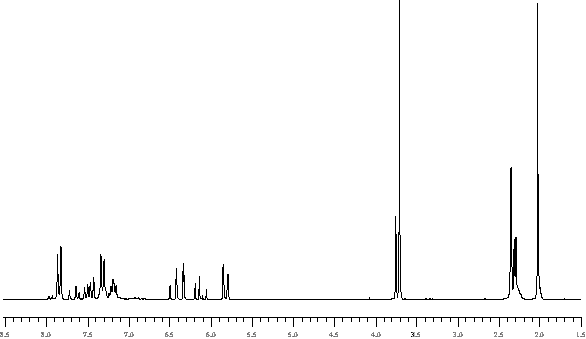
Fig. 1. 1H-NMR spectra of the reaction mixture: p-Tol3Sb(OAc)2 + 1 (1:2), PdCl2 (4 mol%), D3CCOOD, argon, 50 °C: (a) at the start of the reaction; (b) after 3 h; (c) after 24 h.
2.2.3. Transfer of third phenyl group
Organoantimony(III) derivatives Ph2SbX (X = OAc, O2CPh) are involved in the third stage of the phenylation reaction. Like in the case of Ph3Sb, a peroxide oxidizes Ph2SbX to give an active Sb(V) derivative, diphenylantimony triacetate Ph2Sb(OAc)3 18 (Eq. 7) or diphenylantimony tribenzoate Ph2Sb(O2CPh)3 19 (Eq. 8). These compounds react with Pd(0) to give the phenylpalladium intermediate 8 (Eq. 9), which phenylates the third molecule of 1 (Eq. 2). Sb(V) is reduced to phenylantimony(III) dicarboxylate. Thus, peroxide is consumed in oxidation of both triphenyl- and diphenylantimony(III) derivatives.
|
|
(7) |
|
|
(8) |
|
X = OAc, O2CPh
|
(9) |



Another route of Ph2SbX involvement can occur in the presence of oxygen. Matoba et al. [2e] suggested a radical mechanism of this process. In previous work [3] we suggested the speculative mechanism of the oxygen involvement via formation of a palladium hydroperoxide XPdOOH, which oxidized Sb(III) into Sb(V).
We investigated the arylation reaction of 1 with p‑Tol3Sb(OAc)2 13 (Scheme 2) in the presence of oxygen by 1H NMR. The same products 14-17 like under argon were registered. However, in the presence of oxygen the formation of the arylation product 14 was observed in an amount more than an amount of the 13 consumption. The organoantimony(III) compound p‑TolSb(OAc)2 16 was the main product. It was found that oxygen is absorbed 0.5 mol per 1 mol of 5. Thus, the following scheme of oxygen involvement in the transfer of the third phenyl group is realized (Scheme 3). The scheme could be explained by concerted oxidation of two molecules of 12 with an oxygen molecule in the coordination sphere of Pd like in the homogeneous oxidation of phosphines with oxygen on Rh, Co, Pt catalysts [11-13] (Scheme 4).

Scheme 3.

Scheme 4.
Compound 20 in AcOH forms 18 (Eq. 10), which acts with Pd(0) (Eq. 9). Thus, diphenylantimony(V) tricarboxylates are preliminarily formed in the both routes of transfer of the third phenyl group at the third stage of the catalytic cycle. To prove the equation 9 we used diphenylstibine acid Ph2Sb(O)OH as a phenylating agent. In this reaction the yield of 5 was 92% (50 ºC, 12 h, AcOH) (Scheme 5). This fact confirms the mechanism via diphenylantimony tricarboxylates. This stage is a final one and the yield of 5 can reach a value of 300%.
|
|
(10) |


Scheme 5.
The total catalytic cycle is shown on Scheme 6. The active Pd(0) species interact with the initial tetraphenylantimony compound to give phenylpalladium intermediate, which phenylates 1. Triphenylstibine is oxidized by a peroxide to give antimony(V), which reacts with Pd(0) giving PhPdX. As a result, the second molecule of 5 and antimony(III) derivative are formed. Oxygen (or peroxide in excess) oxidizes the latter into antimony(V), which transfers the third phenyl group to methyl acrylate. PhSbX2 (X = OAc, O2CPh), the final product of transformation, is not involved in the C-phenylation reaction in these conditions. The total yield of 5 is 300% in respect to the initial tetraphenylantimony derivative.
Thus, an addition of a peroxide increases an activity of tetraphenylantimony derivatives in the C‑phenylation reaction. The presence of the peroxide provides involvement of three phenyl groups from the initial organoantimony compound via consecutive redox stages. We found that (PhCO2)2 is the optimum peroxide for this system. The reactions can be performed both in AcOH and in CH3CN. It was established that the initial Ph4SbX derivative transforms in this cascade reaction in the following range: Ph4SbX – Ph3Sb – Ph3SbX2 – Ph2SbX – Ph2SbX3 – PhSbX2. The final PhSbX2 derivative is inactive in the C-phenylation under these conditions. The key role of peroxides is oxidation of inactive Ph3Sb or Ph2SbX compounds into an active pentavalent state.

X = O2CEt, OAc or O2CPh
Scheme 6.
2.3. Ar3Sb + Peroxide system in the Pd-catalyzed C-phenylation reaction
We have found for a model reaction, the C-arylation of methyl acrylate, that in the presence of equimolar amounts of peroxide and catalytic amounts of a palladium compound (4 mol %), triarylstibines can act as mild efficient arylating agents (Scheme 7):

Scheme 7
For the reaction of 1 with 21a (3:1) we tested a number of peroxides H2O2, t-BuOOH, (PhCO2)2, (cyclo-C6H11OCO2)2 in order to choose the best. All reactions proceeded under standard conditions (AcOH, 50 °C, 12 h). The results are summarized in Table 2. In all cases the product yield 100% corresponds to the transfer of only one aryl group from an initial organoantimony compound.
All the peroxides exhibited high activity. Peroxides t-BuOOH and H2O2 turned out to be the most effective, giving the yields of the reaction product – methyl cinnamate 171% and 174%, respectively. Peroxide (PhCO2)2 was less efficient (164%). In the case of (cyclo-C6H11OCO2)2 the yield was minimal (127%). A two-fold excess of hydroperoxide t-BuOOH ensured an increase in the product yield but only to a small extent (Table 2, entry 4). The yield of methyl cinnamate did not exceed the stoichiometric yield based on palladium in the absence of the oxidant (Table 2, entry 1). This fact shows that a catalytic reaction does not occur.
The principal role of the peroxides in this given system is the oxidation of Sb(III) to Sb(V) in the form of triarylantimony diacetates. The mechanism of this interaction has been well studied. Triarylantimony diacetates are, as known, effective arylating agents.
Table 2. C-phenylation reaction of methyl acrylate 1 with Ph3Sb/Peroxide/Li2PdCl4 systems a
|
Entry |
Peroxide |
Yields of methyl cinnamate b, % |
|
1 |
- |
2 |
|
2 |
H2O2 |
171 |
|
3 |
t-BuOOH |
174 |
|
4 c |
t-BuOOH |
189 |
|
5 |
(PhCO2)2 |
164 |
|
6 d |
(PhCO2)2 |
121 |
|
7 |
(cyclo-C6H11OCO2)2 |
127 |
|
8 |
PhI(OAc)2 |
26 |
|
9 e |
- |
186 |
aThe reactions were carried out with 0.5 mmol Ph3Sb, 1.5 mmol methyl acrylate, 0.5 mmol peroxide, 0.02 mmol Li2PdCl4 in AcOH (4 ml) for 12 h at 50°C under air.
bThe yields of methyl cinnamate in all cases were determined by GLC.
cThe ratio 21a:t-BuOOH = 1:2.
dAcetonitrile was used as solvent.
ePh3Sb(OAc)2 was utilized instead of 21a.
With benzoyl peroxide the availability of an acid is not obligatory since Ar3Sb transforms to triarylantimony dibenzoate without participation of an acid. Therefore, reactions with benzoyl peroxide can be carried out in neutral solvents, e.g. acetonitrile, but the rate becomes lower (Table 2, entry 6).

While comparing the new systems Ph3Sb/peroxide with the known system based on Ph3Sb(OAc)2, it is seen that they display similar efficiencies (Table 2, entries 3 and 9). Nevertheless, the former differs advantageously from the latter in that the synthesis, isolation and purification necessary for triphenylantimony diacetate are not needed.
To compare with the peroxides, we used another known oxidant PhI(OAc)2 which gives Ph3Sb(OAc)2 on interacting with 21a as well.

However, as seen from our results, the yield of the target product proved to be low (Table 2, entry 8). Moreover, as it turned out, the addition of an equimolar amount of PhI inexplicably inhibits the phenylation reaction under these conditions.
In this C-arylation reaction, other triaryl derivatives of antimony(III) were examined. All reactions were carried out under the standard conditions (AcOH, 50 °C, 12 h) using tert-butyl hydroperoxide. The results are given in Table 3.
As seen, for 21b and 21c the yields of the C-arylated products remained high (180% and 192%, respectively). In the case of the ortho-substituted derivative of antimony 21d the product yield decreased sharply to 125%. With the most sterically hindered 21e, no reaction was observed at all. Thus, the C-arylation reaction depends on steric hindrance in the aromatic ring, especially, in the ortho-position.
As should be expected, better donor substituents reduced the rate of the arylation reaction. So, in the case of 21, the yield of the product was smaller as compared with 21b (Table 3, entries 1 and 5).
Hence, we offer a new catalytic system for C-arylation of unsaturated compounds based on triarylstibines in the presence of equimolar amounts of a peroxide and a catalytic amount of Li2PdCl4 (4 mol %). The role of the peroxides is in the in situ preparation of triarylantimony diacetates without isolation and purification of the latter. H2O2 and t-BuOOH can be considered as the best peroxides. This system enables the reaction to be conducted at low temperatures with transfer of two of the three possible aryl groups. The new system compares favorably with the earlier proposed system based on triarylantimony dicarboxylates.
Table 3. C-arylation reactions of methyl acrylate with Ar3Sb/t-BuOOH/Li2PdCl4 systems a
|
Entry |
Triarylstibine |
Product |
Yields of phenylation product b, % |
|
1 |
|
|
180 |
|
2 |
|
|
192 |
|
3 |
|
|
125 |
|
4 |
|
|
- |
|
5 |
|
|
158 |










aThe reactions were carried out with 0.5 mmol Ar3Sb, 1.5 mmol methyl acrylate, 0.5 mmol peroxide, 0.02 mmol Li2PdCl4 in AcOH (4 ml) for 12 h at 50 °C under air.
bAll C-arylated products were isolated in pure state by column chromatography on silica gel 60 mm and characterized by 1H NMR.
2.4. Ph3Bi + Peroxide system in the Pd-catalyzed C-phenylation reaction
We have found for a model reaction with methyl acrylate, that in the presence of equimolar amounts of benzoyl peroxide and catalytic amounts of a palladium compound (4 mol %), triphenylbismuth can give methyl cinnamate? biphenyl and benzene as coupling products. The results for the three Pd compounds are given in the table 4. Li2PdCl4 is the most active catalyst. BF3∙OEt2 was added to promote peroxide oxidation of triphenylbismuth.
Table 4. C-arylation reactions of methyl acrylate with Ph3Bi/(PhCO2)2/BF3∙OEt2/Li2PdCl4 systems a
|
Entry |
Catalyst |
Yields, % |
|
||
|
PhCH=CHCO2Me |
Ph2 |
PhH |
|
||
|
1b |
Li2PdCl4 |
22 |
80 |
28 |
|
|
2 |
Li2PdCl4 |
45 |
70 |
33 |
|
|
3c |
Li2PdCl4 |
37 |
52 |
0 |
|
|
4 |
PdCl2 |
25 |
57 |
27 |
|
|
5 |
Pd(OAc)2 |
30 |
61 |
28 |
|
aThe reactions were carried out with 0.5 mmol Ph3Bi, 1.5 mmol methyl acrylate, 1 mmol peroxide, 0.02 mmol Li2PdCl4 in MeCN (4 ml) for 4 h at 50 °C under air.
b The reaction free of BF3∙OEt2.
c 30 h at 20ºС.
Benzoyl peroxide is more efficient oxidant than (cyclo-C6H11OCO2)2, H2O2 and especially t-BuOOH.
Table 5. C-arylation reactions of methyl acrylate with Ph3Bi/Peroxide/BF3∙OEt2/Li2PdCl4 systems a
|
Entry |
Peroxide |
Yields, % |
|||
|
PhCH=CHCO2Me |
Ph2 |
PhH |
|
||
|
1b |
t-BuOOH |
<1 |
20 |
23 |
|
|
2c |
t-BuOOH |
<1 |
20 |
117 |
|
|
3d |
(PhCO2)2 |
22 |
80 |
28 |
|
|
4 |
(PhCO2)2 |
45 |
70 |
33 |
|
|
5 |
(cyclo-C6H11OCO2)2 |
10 |
22 |
0 |
|
|
6 |
H2O2 |
07 |
14 |
0 |
|
aThe reactions were carried out with 0.5 mmol Ph3Bi, 1.5 mmol methyl acrylate, 1 mmol peroxide, 0.02 mmol Li2PdCl4 in MeCN (4 ml) for 4 h at 50 °C under air.
b,c,d The reaction free of BF3∙OEt2.
b 24 h at 20ºС.
b,c The reaction in the presence of AcOH 1.5 mmol.
3. Experimental
3.1. General methods
Gas chromatographic analyses were performed with a LKhM-80 chromatograph using helium as the carrier gas, column 100 cm length, 15%-Apiezon-L on the Chromaton N-AW at 220 °C. 1H NMR spectra were measured on a Bruker Avance DPX-200 spectrometer for solutions in D3CCOOD. Column chromatographies were performed with silica gel 60 Merck.
3.2. Typical procedure for the C-phenylation reaction [20]
Ph4SbOH (0.224 g, 0.5 mmol) was dissolved in AcOH (1 ml) in a 50 ml tube. A mixture of t-BuOOH (0.075 ml, 0.75 mmol), Li2PdCl4 (5.2 mg, 0.02 mmol) and methyl acrylate (0.18 ml, 2 mmol) in acetic acid (3 ml) was added to Ph4SbOH solution. The tube was sealed and the reaction mixture was kept at 50 °C for 24 h. The solvent was then evaporated under reduced pressure. The solid residue was purified from inorganic products by elution through a short column on silica gel using a mixture of hexane-diethyl ether (v/v 4:1) as the eluant. The filtrate was analyzed by GLC. Methyl cinnamate (0.208 g) was found.
3.3. Procedure for measurement of oxygen consumption in C-phenylation of methyl acrylate with Ph3Sb(OAc)2
A mixture of Ph3Sb(OAc)2 (0.236 g, 0.5 mmol), PdCl2 (3.6 mg, 0.02 mmol), methyl acrylate (0.135 ml, 1.5 mmol) in acetic acid (4 ml) under air was placed in the 10 ml tube being the reflux condenser. The tube was connected with a gas burette filled by the brine and was placed into the thermostat at 50 ºC. After equating the pressure in the tube and the burette with atmosphere pressure, the tube was locked on the gas burette by the three-way cock. The reaction mixture was kept at 50 ºC. After 12 h, the 0.21 mmol of oxygen was consumed. The yield of methyl cinnamate was 0.88 mmol. The same reaction under argon yielded 0.44 mmol of methyl cinnamate.
3.4. Procedure for 1H-NMR spectroscopic study
PdCl2 (0.9 mg, 0.005 mmol) and p-Tol3Sb(OAc)2 (64.1 mg, 0.125 mmol) were placed into NMR tube under argon. Air-free D3CCOOD (1 ml) and methyl acrylate (0.034 ml, 0.375 mmol) were placed into the tube under argon. The tube was sealed and 1H-NMR analysis was carried out. The reaction mixture was heated at 50 °C. The 1H-NMR spectra were recorded in 3, 12, and 24 h.
References
1. (a) Y.Z. Huang, Acc. Chem. Res. 25 (1992) 182; (b) W.I. Cross, S.M. Godfrey, C.A. McAuliffe, A.G. Mackie, R.G. Pritchard, in: N.C. Norman (Ed.), Chemistry of Arsenic, Antimony and Bismuth, Ch. 5, Blackie Academic and Professional, London, 1998.
2. (a) M. Fujiwara, M. Tanaka, A. Baba, H. Ando, Y. Souma, J. Organomet. Chem. 525 (1996) 39; (b) S.-K. Kang, H.-C. Ryu, Y.-T. Hong, J. Chem. Soc. Perkin Trans. 1 (2000) 3350; (c) S.-K. Kang, H.-C. Ryu, S.-W. Lee, J. Organomet. Chem. 610 (2000) 38; (d) S.-K. Kang, H.-C. Ryu, Y.-T. Hong, J. Chem. Soc. Perkin Trans. 1 (2001) 736; (e) K. Matoba, S. Motofusa, C.S. Cho, K. Ohe, S. Uemura, J. Organomet. Chem. 574 (1999) 3; (f) C.S. Cho, K. Tanabe, S. Uemura, Tetrahedron Lett. 55 (1994) 1275; (g) C.S. Cho, S. Motofusa, K. Ohe, S. Uemura, Bull. Chem. Soc. Jpn. 69 (1996) 2341.
3. D.V. Moiseev, A.V. Gushchin, A.S. Shavirin, Y.A. Kursky, V.A. Dodonov, J. Organomet. Chem. 667 (2003) 176.
4. D.V. Moiseev, V.A. Morugova, A.V. Gushchin, V.A. Dodonov, Tetrahedron Lett. 44 (2003) 3155.
5. A.V. Gushchin, E.V. Grunova, D.V. Moiseev, O.S. Morozov, A.S. Shavirin, V.A. Dodonov, Russ. Chem. Bull., Int. Ed. 52 (2003).
6. (a) J.-P. Finet, Ligand Coupling Reaction with Heteroatomic Compounds, Pergamon Press: Oxford, 1998.
(b) H. Suzuki, T. Ikegami, Y. Matano, Synthesis (1997) 3350.
(c) J.-P. Finet, Chem. Rev. (1989) 1487.
(d) R.A. Abramovitch, D.H.R. Barton, J.-P. Finet, Tetrahedron 44 (1988) 3039.
(e) G.I. Elliot, J.P. Konopeski, Tetrahedron 57 (2001) 5683.
7. D.H.R. Barton, N. Ozbalik, M. Ramesh, Tetrahedron 44 (1988) 5661.
8. M.L.N. Rao, O. Yamazaki, S. Shimada, T. Tanaka, Y. Suzuki, M. Tanaka, Org. Lett. 3 (2001) 4103.
9. X. Huang, J.L. Wu, Chin. Chem. Lett. 8 (1997) 759.
10. M.L.N. Rao, S. Shimada, M. Tanaka, Org. Lett. 1 (1999) 1271.
11. M.L.N. Rao, S. Shimada, O. Yamazaki, M. Tanaka, J. Organomet. Chem. 659 (2002) 117.
12. S.K. Kang, H.C. Ryu, J.W. Kim, Synth. Commun. 31 (2001) 1021.
13. T. Ohe, T. Tanaka, M. Kuroda, C.S. Cho, K. Ohe, S. Uemura, Bull. Chem. Soc. Jpn. 72 (1999) 1851.
14. C.S. Cho, Y. Yoshimori, S. Uemura, Bull. Chem. Soc. Jpn. 68 (1995) 950.
15. S.K. Kang, H.C. Ryu, Y.T. Hong, M.S. Kim, S.W. Lee, J.H. Jung, Synth. Commun. 31 (2001) 2365.
16. R. Asano, I. Moritani, Y. Fujiwara, S. Teranishi, Bull. Chem. Soc. Jpn. 46 (1973) 2910.
17. T. Kawamura, K. Kikukawa, M. Takagi, T. Matsuda, Bull. Chem. Soc. Jpn. 50 (1977) 2021.
18. K. Matoba, S. Motofusa, C.S. Cho, K. Ohe, S. Uemura, J. Organomet. Chem. 574 (1999) 3.
19. Y. Matano, M. Yoshimune, N. Azuma, H. Suzuki, J. Chem. Soc., Perkin Trans. 1 (1996) 1971
20. D.V. Moiseev, V.A.Morugova, A.V. Gushchin, A.S. Shavirin, Y.A. Kursky, V.A. Dodonov, J. Organomet. Chem. 689 (2004) 731.